Introduction
Instant tea powder and liquid tea concentrate can both deliver tea solids and flavor to a commercial beverage, but they create different requirements for storage, dosing, mixing, transport and quality control. The right choice depends less on which format sounds more “natural” or “industrial” and more on how the ingredient fits the complete manufacturing system.
A powder may simplify ambient storage and international freight, yet require careful dispersion and dust control. A liquid concentrate may simplify dosing into some wet processes, yet add water weight, container handling and different microbiological or storage considerations. Flavor profiles can vary within either category because tea type, extraction, clarification, concentration, aroma management, drying and storage all influence the final ingredient.
Short answer: choose the format that performs best against a written process and product brief. Compare the tea profile in the final beverage, concentration and dosing accuracy, process compatibility, storage conditions, pack utilization, landed cost, document package and batch consistency. Do not assume that all powders or all concentrates behave alike.
This article provides a practical decision framework for beverage brands, contract manufacturers, importers and R&D teams. It does not define universal processing parameters or shelf-life claims; those must be validated for the specific ingredient, formula, facility and market.
What is instant tea powder?
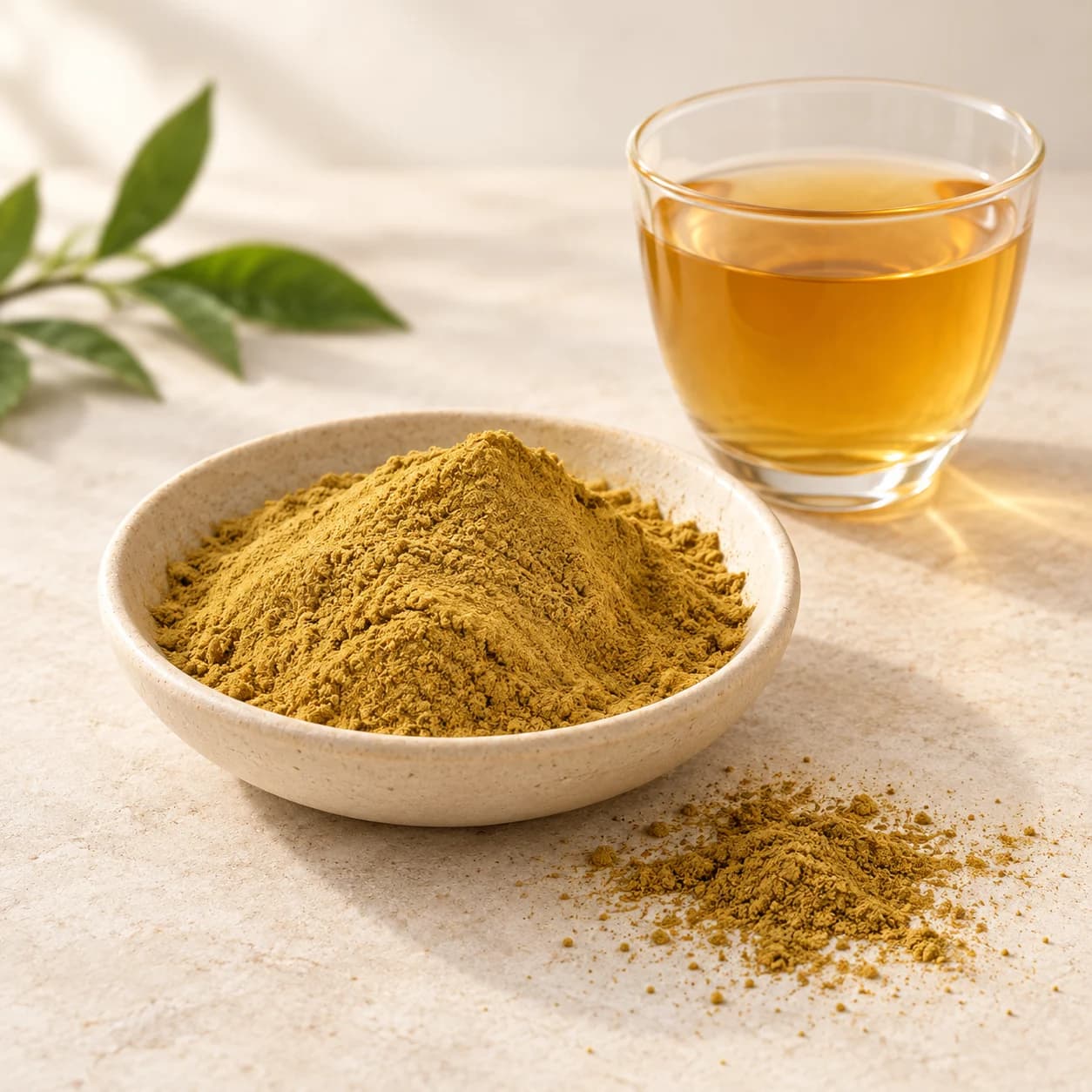
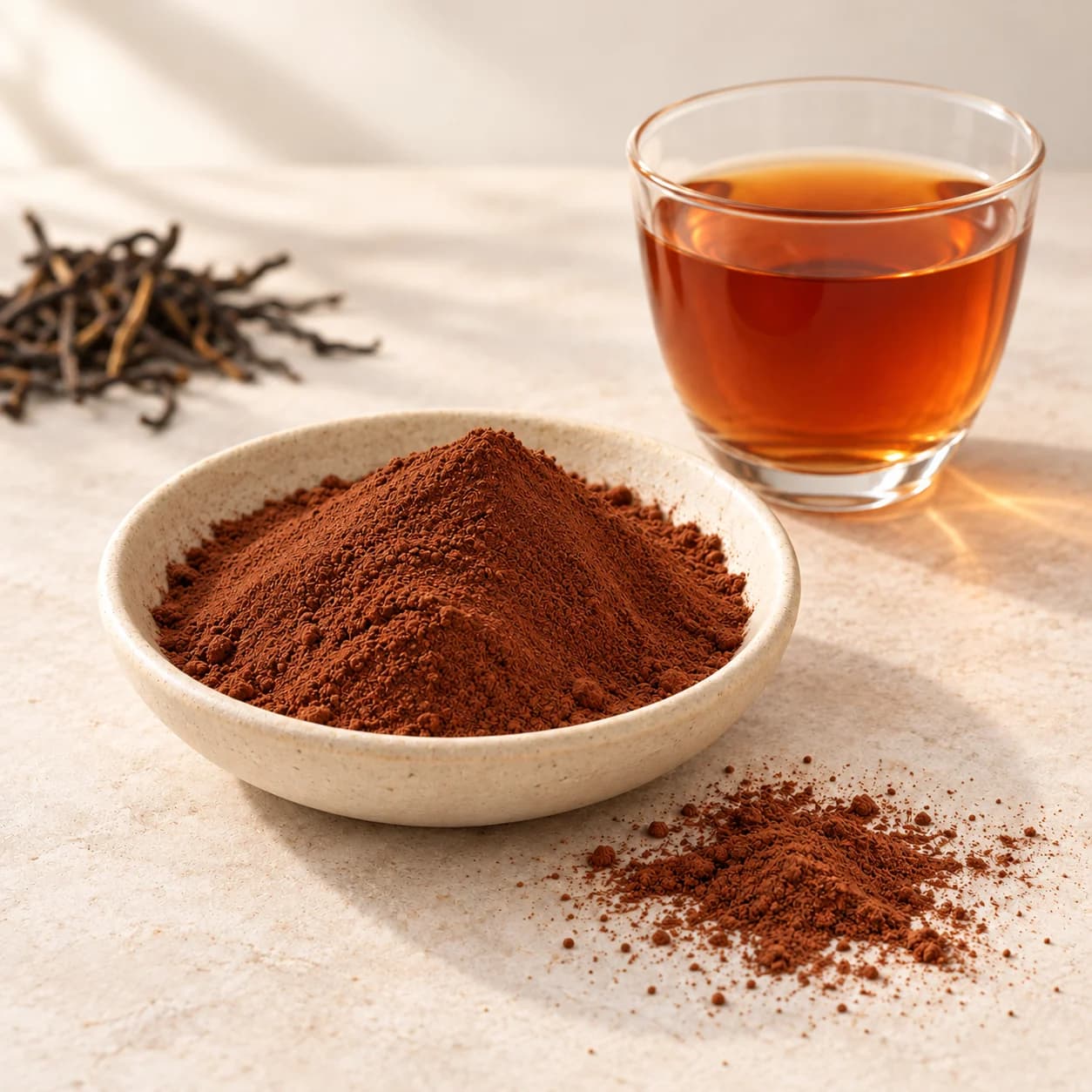
Instant tea powder is generally produced by extracting soluble material from tea, separating or clarifying the extract as needed, concentrating it and drying it into a solid form. Spray drying and freeze drying are among the drying approaches described in tea research, and the chosen raw material and drying process can influence aroma, sensory character, powder structure and reconstitution behavior.
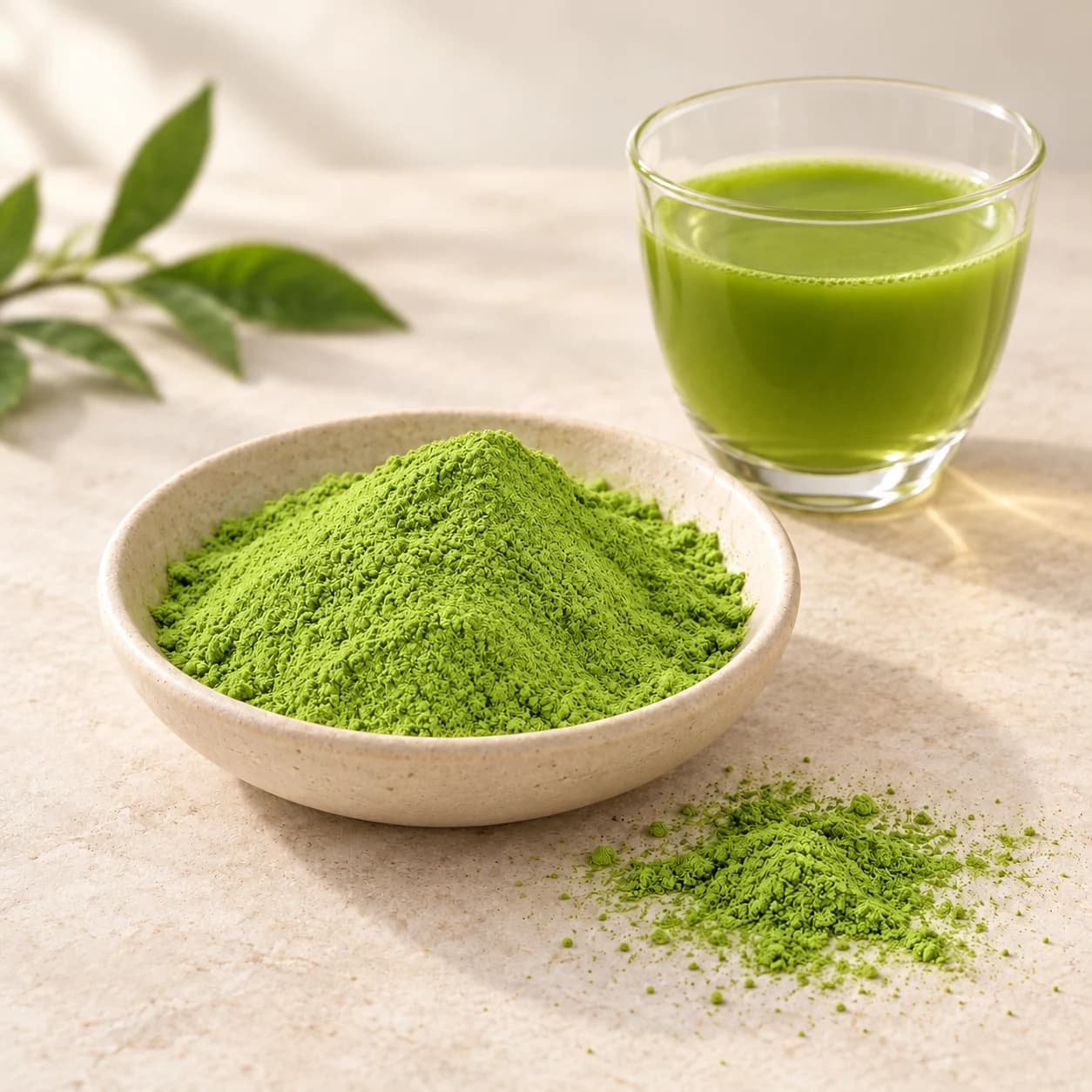
This category should not be confused automatically with ground whole-leaf powder. Matcha and other milled tea powders contain leaf particles and are usually dispersed as suspensions. Instant tea is intended to provide soluble or readily reconstituted tea solids, although practical performance still depends on the grade, temperature, water chemistry, concentration and mixing conditions.
The category also requires precise identity. ISO 6079:2021 specifies requirements for instant tea in solid form, but its stated scope excludes some products, including filled instant tea containing non-tea carbohydrates and certain preparations with added aromatic material. Buyers should therefore ask whether a quoted item is pure instant tea, a tea extract powder with a carrier, or a formulated drink premix. These may all be commercially useful, but they are not interchangeable.
What is tea concentrate?
Tea concentrate is a liquid ingredient containing extracted tea solids at a defined concentration. It may be supplied as a relatively fluid concentrate or a more viscous material, depending on solids, formulation and temperature. Some concentrates are designed for refrigerated or frozen handling; others may use a different preservation and packaging system. The supplier’s specification and process guidance must define the actual product.
Liquid format can be convenient where a facility already meters liquid ingredients into a blend tank and has the right pumps, connections, storage space and sanitation program. It can be less convenient where the plant is optimized for dry blending, where international freight efficiency is critical, or where partial-container use creates handling concerns.
Quick comparison: powder and concentrate
| Decision factor | Instant tea powder | Liquid tea concentrate | What the buyer should verify |
|---|---|---|---|
| Ingredient form | Dry solid | Liquid | Exact identity, tea base, carriers or other ingredients |
| Typical storage question | Moisture protection, temperature, light, resealing | Temperature, microbiological controls, opening and resealing | Supplier storage instruction and evidence supporting shelf life |
| Dosing | Gravimetric dry dosing or pre-slurry | Pumped or manually measured liquid dosing | Equipment accuracy at intended scale |
| Mixing | Wetting and dissolution/reconstitution conditions matter | Pumpability and distribution in the tank matter | Order of addition, temperature, shear and time |
| Freight | Less water transported; potentially compact | Water contributes to shipment mass and volume | Landed cost per unit of usable tea solids |
| Packaging | Bags, pouches, cartons or drums depending on product | Pails, bag-in-box, drums or bulk systems | Pack size, liner, closure and partial-use plan |
| Factory handling | Dust, static, bridging and humidity may matter | Leaks, residue, pumping and sanitation may matter | Receiving, transfer, yield loss and cleaning |
| Sensory | Depends on tea, process and drying | Depends on tea, process and concentration | Blind test in the final beverage |
| Quality control | Powder moisture, bulk handling and reconstitution may be relevant | Solids, viscosity, density and microbiological controls may be relevant | Product-specific specification and batch COA |
The table is a screening tool, not a verdict. A well-designed concentrate can outperform an unsuitable powder in one plant, while a well-chosen powder can be the more robust choice in another.
Compare the formats through the finished-product brief
Before contacting suppliers, define what the ingredient must accomplish. Include:
- beverage type and flavor direction;
- tea type: black, green, oolong, jasmine, Pu’er, dark tea, white tea or another defined base;
- target tea solids or sensory strength;
- sweetness, acidity, dairy or plant-base system;
- still, carbonated or powdered finished format;
- batch size and production frequency;
- water quality and blending temperature;
- heat treatment, homogenization, filtration and filling process;
- target package and intended shelf-life study;
- factory’s dry and liquid ingredient-handling capabilities;
- destination market, label constraints and required documents.
The same product concept can produce a different format decision in two factories. A high-volume plant with automated liquid dosing may value a pumpable concentrate. A distributed co-packing network may prefer a dry ingredient that is easier to allocate among sites. A dry drink mix normally starts with different constraints from a bottled RTD tea.
Formulation and sensory differences
Tea character should be judged after processing
Taste the ingredient in water to understand its baseline, then evaluate it in the complete formula. Sugar, acid, milk proteins, plant bases, flavors and other botanicals can change perceived tea body, bitterness, astringency, aroma and color. Heat and holding time may create further differences.
Use blind-coded samples where possible. Prepare them at equivalent finished-beverage targets rather than equal ingredient weights, because the concentration of tea solids can differ. Record the calculation and the supplier’s basis for solids or recommended dosage.
Aroma is a process question, not simply a format claim
Powder production includes a drying step, while concentrate production includes concentration and a liquid preservation/handling system. Either process can influence volatile aroma. Some instant-tea processes include aroma recovery or addition steps; some concentrates may be designed around a particular aroma profile. Buyers should compare actual samples and request an accurate ingredient declaration rather than assuming “liquid equals fresher” or “powder equals weaker.”
Color and clarity require application testing
For clear or lightly colored beverages, haze, tea cream, sediment and color shift can be critical. The outcome depends on tea chemistry, extraction and clarification, concentration, pH, water minerals, temperature and formulation. Ask for application guidance, but validate under your own process and hold conditions.
Factory handling and installation preparation
Ingredient selection often fails when the R&D sample is approved without involving production. Before changing formats, walk the proposed material through receiving, storage, weighing or pumping, blending, cleaning and waste handling.
Preparing for instant tea powder
Review:
- pallet and pack dimensions;
- dry-storage temperature and humidity controls;
- open-pack resealing or full-pack batch sizing;
- dust extraction and operator exposure assessment;
- weighing accuracy and powder-transfer method;
- screen, hopper, eductor or pre-slurry needs;
- powder addition rate and sequence;
- risk of bridging, static or material left in the package;
- sanitation and cross-contact controls.
Do not add a fine powder rapidly to a poorly moving liquid and then conclude that the ingredient is insoluble. Establish an addition method that exposes particles to sufficient liquid movement without creating excessive foam or dust.
Preparing for tea concentrate
Review:
- unloading and internal transport method;
- storage temperature and space;
- viscosity at the actual handling temperature;
- pump, hose, connector and seal compatibility;
- container agitation if permitted or required;
- complete drainage and recoverable yield;
- partial-pack storage and use period after opening;
- sanitation of transfer equipment;
- leak response and waste-water load.
A tote or drum that looks efficient on a quotation may create labor and yield loss if the plant cannot empty it cleanly. Conversely, a concentrate in a well-matched bag-in-box or metering system may reduce weighing steps and improve repeatability.
Storage, packaging and logistics
Powder generally avoids transporting the water present in a liquid concentrate. That can improve freight and warehouse efficiency, especially for international supply. However, cost comparisons must use usable tea solids, not only price per kilogram. Include pack utilization, losses, reconstitution, labor, storage energy, inventory risk and disposal.
For powder, moisture ingress can cause clumping and performance changes. Confirm the barrier structure, closure, storage instruction and handling after opening. For concentrate, confirm the required temperature, unopened and opened handling instructions, container integrity, and whether freezing or temperature excursions affect use.
Do not accept a shelf-life number without understanding its basis. Ask which package, storage condition and product version it covers and whether the supplier can provide relevant support. Your finished beverage still requires its own shelf-life validation.
Quality-control and document differences
Both formats need a product-specific specification and batch identification. The relevant fields may differ.
For instant tea powder, the buyer may review:
- product identity and tea base;
- ingredient/carrier status;
- appearance and sensory description;
- moisture or other agreed physical criteria;
- solubility or reconstitution method and acceptance approach;
- bulk-density or flow information if important to packing;
- microbiological and contaminant criteria based on the risk assessment;
- packaging, storage and lot coding.
For liquid concentrate, the buyer may review:
- product identity and tea base;
- ingredient declaration;
- soluble-solids basis, density or concentration definition;
- appearance and sensory description;
- pH or viscosity where relevant and method-defined;
- microbiological criteria and preservation system as applicable;
- packaging, storage temperature, opened handling and lot coding.
Do not copy the same COA template across formats merely for convenience. Each reported result needs an agreed method, unit, limit or target and a clear link to the shipped lot. A COA is useful evidence, but it does not replace supplier qualification, risk assessment or application approval.
Run a side-by-side production evaluation
A fair comparison uses a written protocol and equivalent beverage targets.
1. Define the basis of comparison
Decide whether samples will be normalized by tea solids, sensory strength, color target or another justified basis. Document the calculation. Comparing one kilogram of powder with one kilogram of concentrate is rarely meaningful without concentration data.
2. Prepare both ingredients correctly
Follow the supplier’s recommended starting conditions, then adapt within the factory’s realistic operating window. Record water temperature, order of addition, mixing energy and time.
3. Measure operating impact
Record total preparation time, labor, dust or spill observations, packaging waste, transfer loss, tank residue, foam, filtration behavior and cleaning time. For automated dosing, verify repeatability across multiple additions.
4. Compare finished beverage results
Use blind sensory evaluation and defined physical observations. Evaluate immediately after processing and at relevant checkpoints in the development stability plan. Do not extrapolate shelf life from a short bench hold.
5. Compare landed and conversion cost
Include ingredient cost, international and domestic freight, duty assumptions where applicable, storage, energy, handling, yield loss, disposal and quality-control burden. Note which numbers are confirmed and which remain estimates.
6. Review supply continuity
Compare MOQ, lead time, capacity evidence if required, backup planning, change-notification practice and the supplier’s ability to provide consistent documents. These details must be confirmed with the supplier rather than inferred from the ingredient format.
When instant tea powder may fit better
Powder may be a strong candidate when:
- ambient dry storage is preferred and supported by the specification;
- freight and warehouse efficiency are major priorities;
- the factory already handles dry ingredients effectively;
- the product is a dry beverage mix or premix;
- production runs are intermittent and suitable pack sizes are available;
- multiple sites need smaller allocations from a common supply;
- the required tea profile is available in a powder that passes the application test.
These are reasons to test powder, not guarantees of superiority.
When tea concentrate may fit better
Concentrate may be a strong candidate when:
- the plant has reliable liquid receiving and metering systems;
- wet batching is continuous or high volume;
- the specific concentrate gives the required sensory result;
- storage temperature, opened handling and sanitation are manageable;
- the pack size aligns closely with batch size;
- eliminating powder handling solves a real operational constraint.
Again, the actual supplier product and factory system determine the result.
A practical selection scorecard
Score each candidate on a consistent scale, then weight the categories according to the project:
| Category | Example questions |
|---|---|
| Sensory fit | Does tea character survive the complete formula and process? |
| Physical performance | Are clarity, sediment, dissolution/dispersion and color acceptable? |
| Process fit | Can the plant dose, mix and clean reliably? |
| Quality fit | Are specification, test methods and batch documents adequate? |
| Logistics fit | Are storage, freight, pack size and inventory practical? |
| Commercial fit | What is the landed cost per acceptable finished unit? |
| Supply fit | Can the supplier support continuity, traceability and change control? |
Keep the raw observations alongside the score. A weighted total should support judgment, not hide a critical failure such as an unmanageable storage condition or missing regulatory document.
FAQ
Is instant tea powder the same as tea concentrate?
No. Instant tea powder is a dry form produced from tea extract, while tea concentrate is supplied as a liquid. Exact compositions and processes vary, so buyers should confirm ingredient identity, carrier or additive status, concentration basis and intended use.
Is instant tea powder fully soluble in cold water?
Cold-water performance is product-specific. Request the supplier’s test method and evaluate the powder at the intended concentration, temperature, water chemistry and mixing conditions. “Instant” should not replace application testing.
Which format is better for RTD tea?
Neither is universally better. The decision depends on sensory target, clarity, process, dosing equipment, storage, packaging, logistics, quality requirements and total conversion cost.
Is powder always cheaper to ship?
Powder commonly avoids shipping the water contained in liquid concentrate, but the complete landed-cost comparison must include concentration, pack utilization, freight class, handling, losses, storage and the amount needed per finished beverage.
Can we replace concentrate with powder at the same dosage?
Not without calculation and testing. Tea-solids concentration, sensory strength and formulation behavior may differ. Reformulate on a justified basis and repeat process and stability evaluation.
What documents should we request from an instant tea powder supplier?
Request a current product specification, ingredient/carrier statement, representative and batch COA plan, storage and packaging information, traceability details and the food-safety or market documents required by your risk assessment.
Conclusion
The powder-versus-concentrate decision should be made at the system level. Start with the finished beverage and factory, compare properly identified samples on an equivalent basis, measure process and logistics consequences, and review the supporting specification and batch documents.
Instant tea powder is often attractive for dry handling, storage and international distribution. Tea concentrate can fit plants designed around liquid dosing and may deliver the preferred result in a particular formula. The best format is the one that the entire team—R&D, production, quality, procurement and logistics—can control consistently.
Final CTA: request an application-matched tea powder sample
Considering Instant Green, Black, Oolong, Jasmine, Pu’er or another tea powder? Send Your Requirements with the beverage type, target profile, process, annual estimate, destination market and document needs. Healsun can discuss sample directions for evaluation against your current concentrate or tea base.