
Introduction
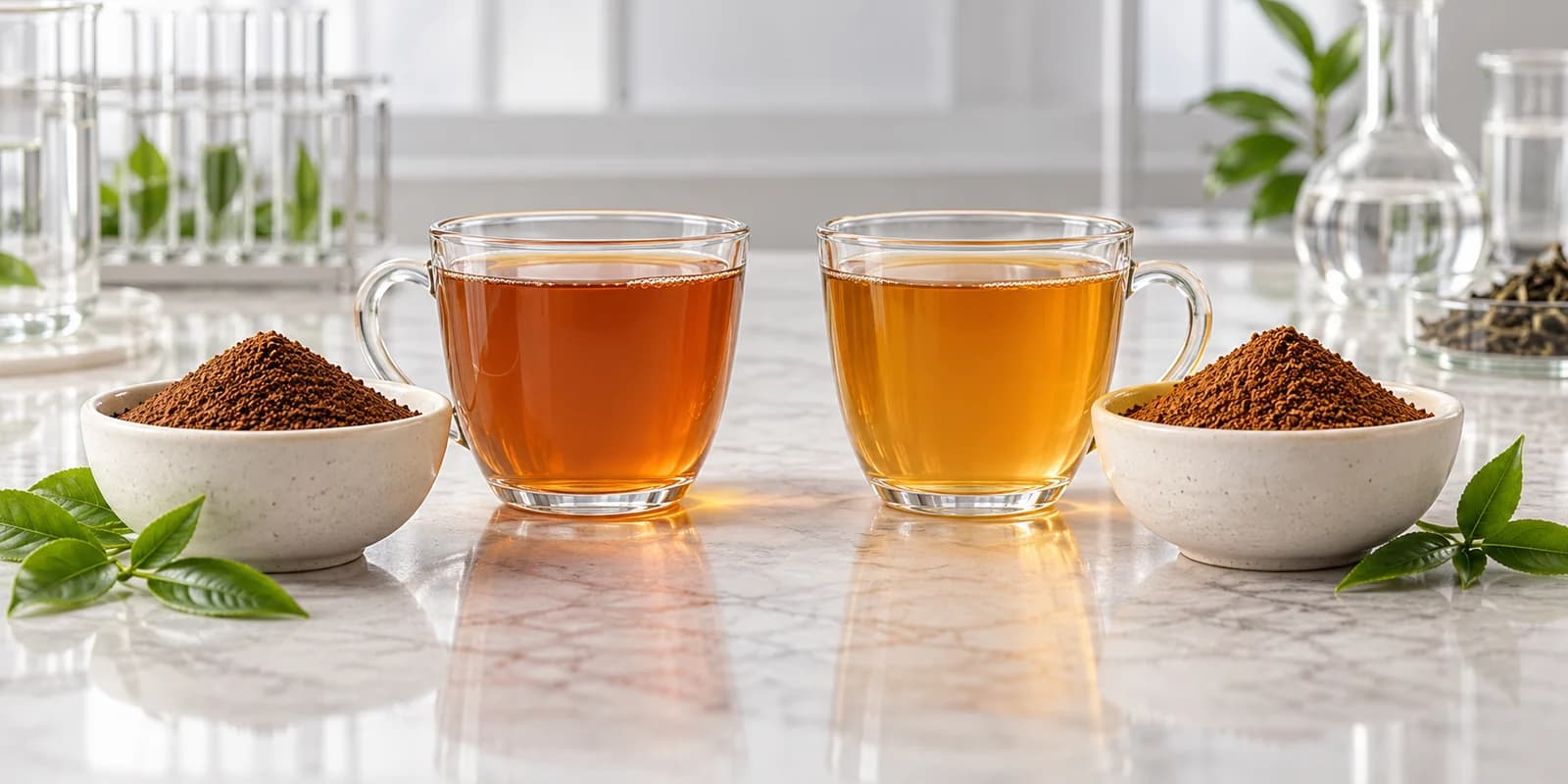
Cold-soluble instant tea powder is designed to disperse and dissolve in cool water more readily than a product intended only for hot preparation. For an iced-tea or ready-to-drink project, however, the phrase “cold soluble” is not a complete specification. Water temperature, dosage, agitation, water chemistry, sweeteners, acids and the required clarity all affect the result.
A powder that appears clear at low dosage in laboratory water may haze after acidification, leave foam after high-shear mixing, or develop sediment during a finished-product hold. Another sample may dissolve more slowly yet deliver the preferred tea aroma and color. Procurement therefore needs a method that connects supplier claims with the actual formula and process.
Short answer: qualify cold-soluble instant tea powder with a defined test rather than a label claim. Set the water temperature, dosage, mixing method and observation times; compare dissolution, undissolved particles, haze, foam, color, aroma and taste; then repeat the test in the complete beverage. Approve the identified sample, specification and commercial-lot controls together.
This guide is for beverage developers, importers, private-label brands and quality teams sourcing instant black, green, oolong, jasmine or related tea powders. It provides a decision framework, not universal acceptance limits. Final limits should be based on the chosen product, destination market, beverage design and validated manufacturing process.
What does “cold soluble” mean for instant tea powder?
In commercial language, cold soluble usually means that a dried tea extract can be reconstituted in cool or ambient water without the heat normally used to prepare tea. The practical requirement may range from “dissolves in 20°C water with moderate agitation” to “disperses into a 5°C beverage base within a short factory mixing cycle.” Those are different technical tasks.
Instant tea is generally produced by extracting soluble material from tea and drying the concentrated extract. This distinguishes it from finely ground whole-leaf powders, which contain suspended plant particles. ISO 6079:2021 covers requirements for instant tea in solid form, while excluding certain filled, flavored, decaffeinated and non-Camellia-sinensis products. A buyer should therefore confirm whether the offered material is a pure instant tea, a formulated powder with a carrier, or another tea ingredient category.
The word “soluble” also needs a test definition. It may refer to the percentage of solids recovered after a laboratory procedure, the absence of visible particles, the time needed to prepare a drink, or the visual clarity of the reconstituted liquid. These outcomes are related but not interchangeable.
Ask the supplier to define the claim
Before requesting a sample, ask four direct questions:
- At what water temperature is the product described as cold soluble?
- At what dosage and liquid-to-powder ratio was it evaluated?
- Which mixing method and mixing time were used?
- How were undissolved material, haze or sediment assessed?
An answer such as “completely soluble” is difficult to use without these conditions. A useful answer identifies a test method or provides enough detail for the buyer to reproduce the screening test.
Start with an iced or RTD beverage brief
The supplier cannot recommend a relevant starting sample from the words “instant tea powder” alone. A useful inquiry explains what the beverage must become.
Include the following information:
- tea type and desired flavor direction;
- finished beverage: freshly prepared iced tea, fountain syrup, powdered premix, concentrate or packaged RTD;
- intended dosage range;
- make-up water temperature and approximate water hardness;
- sugar, high-intensity sweetener, acid, juice, flavor, milk or plant-base components;
- target pH, if already defined by the formulator;
- required appearance: clear, slightly hazy, opaque or milk-based;
- mixing equipment, batch size and available mixing time;
- heat treatment, filtration, homogenization and filling process;
- expected shelf-life study and storage conditions;
- destination market, pack size and required documents.
This brief lets the supplier distinguish an application need from a generic sample request. It also helps the buyer avoid approving a sample under conditions that cannot be repeated in production.
Decide what “good” means before testing
A procurement team may focus on unit price while R&D focuses on flavor and operations focuses on mixing time. Put the criteria in one scorecard before samples arrive.
For an iced or RTD project, the scorecard may include:
- tea identity and sensory direction;
- dissolution time under the agreed cold-water screen;
- visible particles immediately after mixing;
- haze or sediment after defined hold intervals;
- foam generation and foam collapse;
- color under controlled lighting;
- taste at intended serving temperature;
- performance after acid, sweetener and flavor addition;
- behavior after the planned thermal and filling process;
- document completeness and lot traceability;
- landed cost at the actual use level, not price per kilogram alone.
The weighting should reflect the commercial product. Crystal clarity may be essential for one bottled tea and irrelevant for a milk tea.
Build a reproducible cold-water dissolution test
A bench test should be simple enough to repeat and controlled enough to compare. The objective is not to imitate every factory condition at once. It is to create a consistent first screen and then move qualified samples into the real formula.
Step 1: identify and condition every sample
Record the supplier name, product name, sample code, lot reference, date received and packaging condition. Store samples according to the supplied instruction and allow them to reach the same laboratory temperature before comparison. If one sample has absorbed moisture after opening, its flow and wetting may no longer represent an unopened commercial pack.
Step 2: standardize the water
Use the same water source for every sample. Record temperature, volume and relevant water-quality information. Mineral content and pH can influence beverage appearance and flavor, so purified laboratory water and factory water should not be treated as automatically equivalent.
Run at least one screen at the actual cold-processing temperature. If the factory uses 10°C water but the supplier demonstrates the powder at 25°C, the buyer still needs a 10°C test.
Step 3: standardize powder addition and mixing
Set the powder mass, liquid volume, order of addition, mixer type, speed and mixing duration. Add powder consistently—for example, over the same number of seconds into the same vortex position. Powder dumped as one mass can create dry-centered agglomerates that a controlled addition avoids.
Record:
- time until no dry powder remains on the surface;
- time until no obvious agglomerates remain;
- foam height immediately after mixing;
- liquid temperature before and after mixing;
- any powder adhering to the vessel or mixer.
Do not change the mixing method for a difficult sample during the comparison. Complete the controlled screen first, then run a separate process-optimization test.
Step 4: observe immediately and over time
Inspect the drink under consistent lighting immediately after mixing and at predetermined intervals such as 5, 30 and 60 minutes. Longer intervals may be relevant to the production hold.
Evaluate:
- floating particles or surface film;
- visible sediment;
- ring formation on the vessel;
- haze and color uniformity;
- foam persistence;
- aroma and taste change.
A photograph can support records but should not replace direct assessment. Camera exposure, white balance and screen settings change the apparent color and clarity.
Step 5: retain a sample and the method
Keep a clearly labelled retention sample when practical. Save the exact preparation method with the result. A statement such as “Sample B dissolved best” has limited value if the team cannot reproduce the test six months later.
Cold-water screening is not finished-product approval
Water screening answers whether a powder is practical to reconstitute under a defined simple condition. It does not show how the powder will behave after acids, sweeteners, minerals, flavors, juice or dairy components are added.
Prepare the shortlisted samples in the complete formula using the intended order of addition. For an acidic RTD tea, observe what happens as pH changes. For a sweetened iced tea, compare flavor and haze after the sweetener system is incorporated. For a milk tea, assess whether the tea character remains recognizable and whether the combined system produces an acceptable color and mouthfeel.
Evaluate the attributes that influence the buying decision
Dissolution and process time
Faster dissolution may reduce mixing time, but the benefit should be measured in the real process. A powder that dissolves rapidly at bench scale may foam excessively under factory shear. Another may require a premix step that is acceptable for a small batch but impractical for continuous production.
Map the result to operations: dosing accuracy, dust control, addition rate, mixer availability, tank turnover and cleaning. “Cold soluble” creates value only when it improves the complete manufacturing task.
Clarity, haze and sediment
Clarify the required appearance before rejecting a sample. Tea naturally contains compounds that can influence color and haze, and the finished beverage matrix may change their behavior. If clarity is a critical quality attribute, define an objective or controlled visual method and observe the product through the intended shelf-life study.
Do not use a single fresh-beverage photograph as evidence of long-term stability. Commercial approval requires appropriate stability work for the formula, process, packaging and storage conditions.
Flavor at serving temperature
Cold serving temperature can reduce aroma perception and change the balance of bitterness and astringency. Evaluate tea powders in the intended drink, at the intended serving temperature and dosage. A sample chosen only from hot tasting may not deliver the same preference when chilled.
Use coded samples and a consistent preparation order. Record tea aroma, body, bitterness, astringency, aftertaste and any cooked or stale notes. If one product needs more powder to reach the target tea character, compare cost at the effective dosage.
Color and process response
Assess color after the complete process, not only after cold dissolution. Heat, oxygen, light, pH and storage can change appearance. Use a controlled visual reference or instrumental method when color consistency is commercially important.
Powder handling
Observe flow, clumping and dust during the trial. Ask how the commercial product is packed, what pack size is proposed and how opened material should be protected. Dried powders can take up moisture from humid air; the practical controls include suitable barrier packaging, prompt resealing and storage according to the supplier’s instructions.
What specifications and documents should a buyer request?
The exact document package depends on the product, intended use and destination market. A practical starting request includes:
- current product specification and product code;
- ingredient or composition statement;
- representative or batch-specific certificate of analysis, clearly identified;
- sensory and physical criteria relevant to the product;
- stated solubility or preparation method, where applicable;
- moisture, storage and packaging information;
- shelf-life basis and lot-coding explanation;
- allergen statement and cross-contact information relevant to the site;
- available microbiological, contaminant and residue information required by the buyer’s risk assessment;
- food-safety certificates only where current, authentic and applicable;
- change-control expectations;
- commercial pack, minimum order, lead-time and export-document details.
ISO 6079:2021 confirms that instant tea in solid form has a dedicated international specification, but the buyer should check whether the offered product falls within that standard’s scope. A filled or flavored preparation may require different identity and composition discussions.
Never assume that the words “cold soluble” establish regulatory compliance, shelf life or suitability for a particular beverage. Those conclusions require product-specific documents and application validation.
Pilot-scale and pre-shipment checks
Move the preferred sample into a pilot or factory trial before full approval. Record powder addition, wetting, mixing time, foam, tank-wall deposits, pump or filtration behavior, yield and cleaning observations. Compare the finished drink with the approved bench reference.

Before the first commercial shipment, align:
- exact product code and approved sample reference;
- specification revision;
- commercial pack and label information;
- batch documents to be issued;
- shipment inspection responsibilities;
- retention-sample and complaint-investigation process;
- change-notification expectations.
During shipment inspection, verify quantity, lot identification, packaging condition and document consistency. Do not treat a visual inspection as a substitute for required laboratory release testing.
Common purchasing mistakes
Treating “cold soluble” as a universal property
Solubility depends on test conditions. Require the temperature, dosage and mixing method behind the claim.
Approving in warm water for a cold process
A 40°C demonstration may be useful, but it does not prove performance in a 5–10°C manufacturing process.
Testing water only
Acid, sugar, minerals, flavor and other ingredients can change the result. Approve in the final matrix and process.
Comparing price per kilogram only
Include effective dosage, mixing time, yield, packaging, freight, waste and document support.
Losing the sample-to-lot connection
Record the approved sample, specification and method used to check commercial lots.
FAQ
Is cold-soluble instant tea powder the same as regular instant tea powder?
Not necessarily. Both are dried tea extracts, but a supplier may use “cold soluble” to identify a product evaluated or processed for easier use in cool water. Ask for the exact temperature, dosage and mixing method behind the description, then repeat the test in your process.
What water temperature should be used to test cold-soluble tea powder?
Use the temperature relevant to the intended manufacturing process and record it precisely. A buyer may also run a controlled comparison at a standard laboratory temperature, but that screen should not replace testing at the factory’s actual cold-water condition.
Does cold-soluble instant tea always make a clear drink?
No. Dissolution and clarity are different outcomes. Tea composition, dosage, water chemistry, pH and other formula ingredients can influence haze. Define whether the finished product must be clear, slightly hazy or opaque, then evaluate it through the planned process and stability program.
Can cold-soluble instant tea be added directly to a mixing tank?
Possibly, but the addition method should be validated. Powder flow, addition rate, vortex position, mixer energy and batch size affect wetting, agglomeration and foam. A pilot trial should confirm the practical procedure before routine production.
Which tea types are available as cold-soluble powders?
Commercial portfolios may include black, green, oolong, jasmine and other instant tea powders, but availability and performance are product-specific. State the tea type and sensory target in the inquiry and ask the supplier to identify the exact sample and supporting documents.
Is a certificate of analysis enough to approve the product?
No. A COA is one part of qualification. Approval should also connect the sample, specification, application test, supplier review, commercial-lot controls, packaging and required destination-market documentation.
Conclusion
Cold-soluble instant tea powder should be selected as a process-and-application ingredient, not from a marketing phrase alone. The strongest purchasing workflow defines the beverage, requests a reproducible solubility method, controls the cold-water screen, tests the complete formula and confirms factory handling before commercial approval.
The final decision should connect four records: the identified sample, the finished-product test, the current specification and the commercial-lot release process. That connection gives procurement, R&D, quality and production a shared basis for ordering and troubleshooting.
Final CTA: discuss your cold-beverage requirement
Developing an iced tea, beverage concentrate or RTD product? Send Your Requirements with the tea type, water temperature, formula, process, destination market and expected volume. Healsun can discuss relevant instant tea powder options and the product-specific information to confirm before sampling or ordering.