Introduction
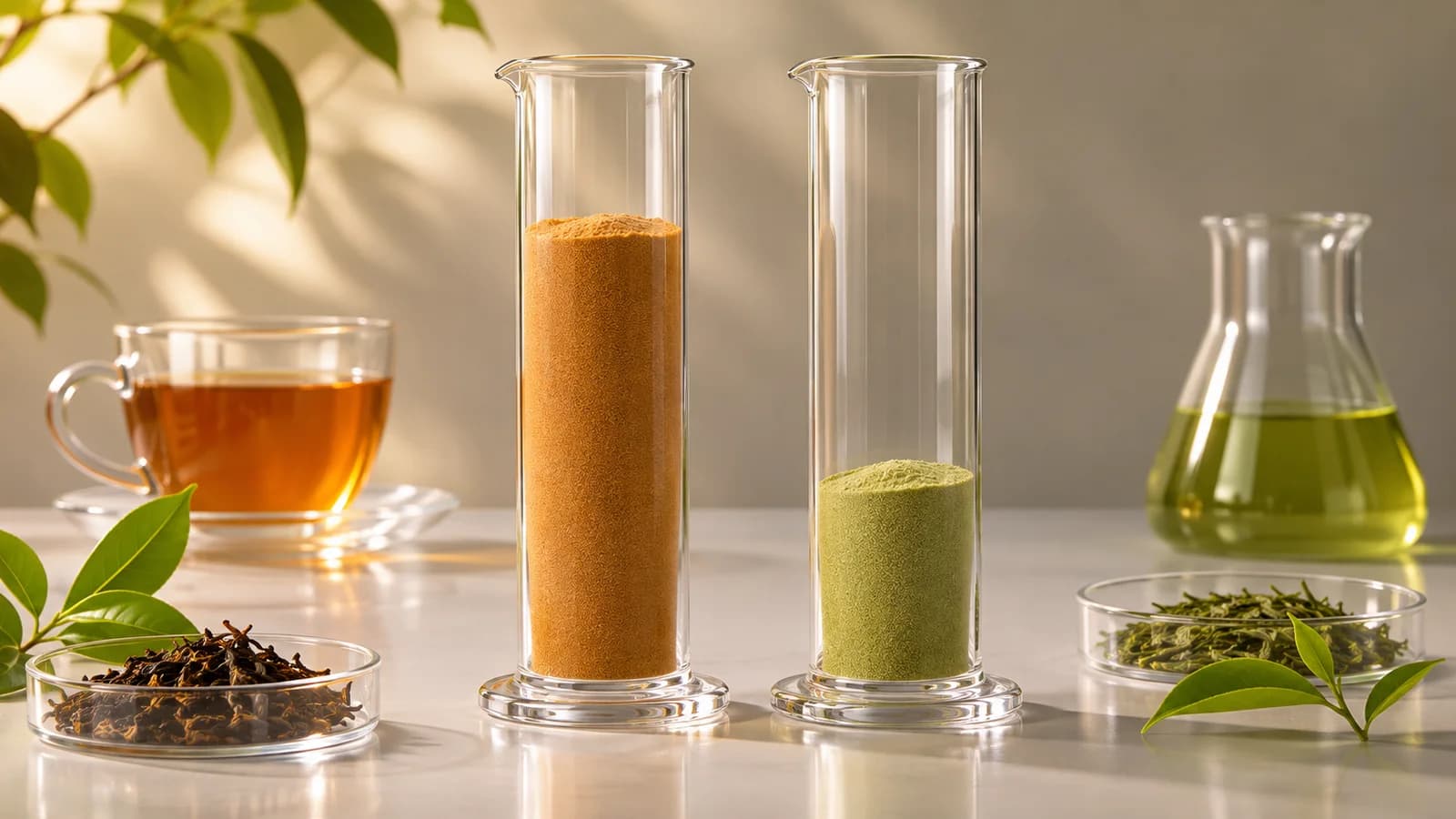
Two instant tea powders can have similar flavor direction and still occupy different package volumes or feed differently through a hopper. Bulk density and flowability describe physical handling behavior; they do not rank sensory quality and they should not be inferred from a product photograph.
Short answer: Buyers should compare bulk density and flow behavior with defined methods, representative samples and the intended equipment. Align the reporting basis, sample conditioning and test procedure, then run dosing and packing trials that track mass accuracy, bridging, dust, clean-down and output consistency. A laboratory value is an input to equipment validation, not a guarantee of production performance.
What bulk density means
Bulk density is the mass of powder occupying a defined bulk volume, including the spaces between particles. ISO 6770 specifies methods for free-flow and compacted bulk densities of instant tea. In the free-flow method, powder is poured through specified apparatus into a known volume and weighed. In the compacted method, a known mass is subjected to a fixed tapping procedure before volume is read.
The two values answer different questions. Free-flow bulk density describes a loose filling condition under the method. Compacted bulk density shows how volume changes after standardized settling. Neither value is the true density of the solid particles.
Why buyers care
Bulk behavior can influence:
- container and liner volume planning;
- hopper refill frequency;
- volumetric feeder calibration;
- mass delivered per auger rotation or cup volume;
- blending sequence and segregation risk;
- dust-control and housekeeping planning;
- package fill height; and
- transport settling.
ISO 6079:2021 notes that requirements for free-flow and compacted bulk density and flowability are subject to agreement between supplier and packer. This is a useful commercial principle: agree on the characteristic and method that matter to the actual process instead of treating one generic number as universally acceptable.
Bulk density is not flowability
A dense powder is not automatically free flowing, and a low-density powder is not automatically difficult. Flow depends on particle size distribution, shape, surface properties, moisture, electrostatic behavior, consolidation and equipment geometry. The word “flowability” is therefore incomplete unless the test and process context are stated.
Useful observations include:
| Question | Possible measurement or trial |
|---|---|
| How much mass fits a defined volume? | Free-flow bulk density |
| How much does the powder settle under a defined procedure? | Compacted bulk density |
| Does it discharge through an opening? | Method-defined flow or equipment discharge trial |
| Does it bridge or form a stable arch? | Hopper trial under controlled fill and vibration conditions |
| Is dosing repeatable? | Repeated gravimetric checks at intended feeder settings |
| Does handling create airborne dust? | Controlled observation and occupational assessment |
Build a comparable data request
Ask for the exact product and lot, method reference, unit, sample condition, number of replicates and whether the value is typical, a specification limit or a lot result. Confirm whether the sample was conditioned for temperature or humidity and whether the result was measured before or after transport.
Do not compare kilograms per cubic metre with grams per millilitre until units are converted correctly. Do not compare a tapped result with a loose-fill result. If one supplier reports a range and another reports a single typical value, those data have different meanings.
A practical handling and dosing trial
1. Define the process question
State whether the decision concerns bag size, storage bin, screw feeding, loss-in-weight dosing, volumetric cups, dry blending or another operation. One trial rarely answers every handling question.
2. Preserve sample identity
Record lot or sample code, receipt date, package condition and storage history. Use enough material to represent the equipment scale without consuming the complete retained sample.
3. Measure loose and compacted behavior
Use the agreed method and calibrated mass and volume equipment. Run replicates and record individual results rather than only an average. Investigate large variation before using the value for design.
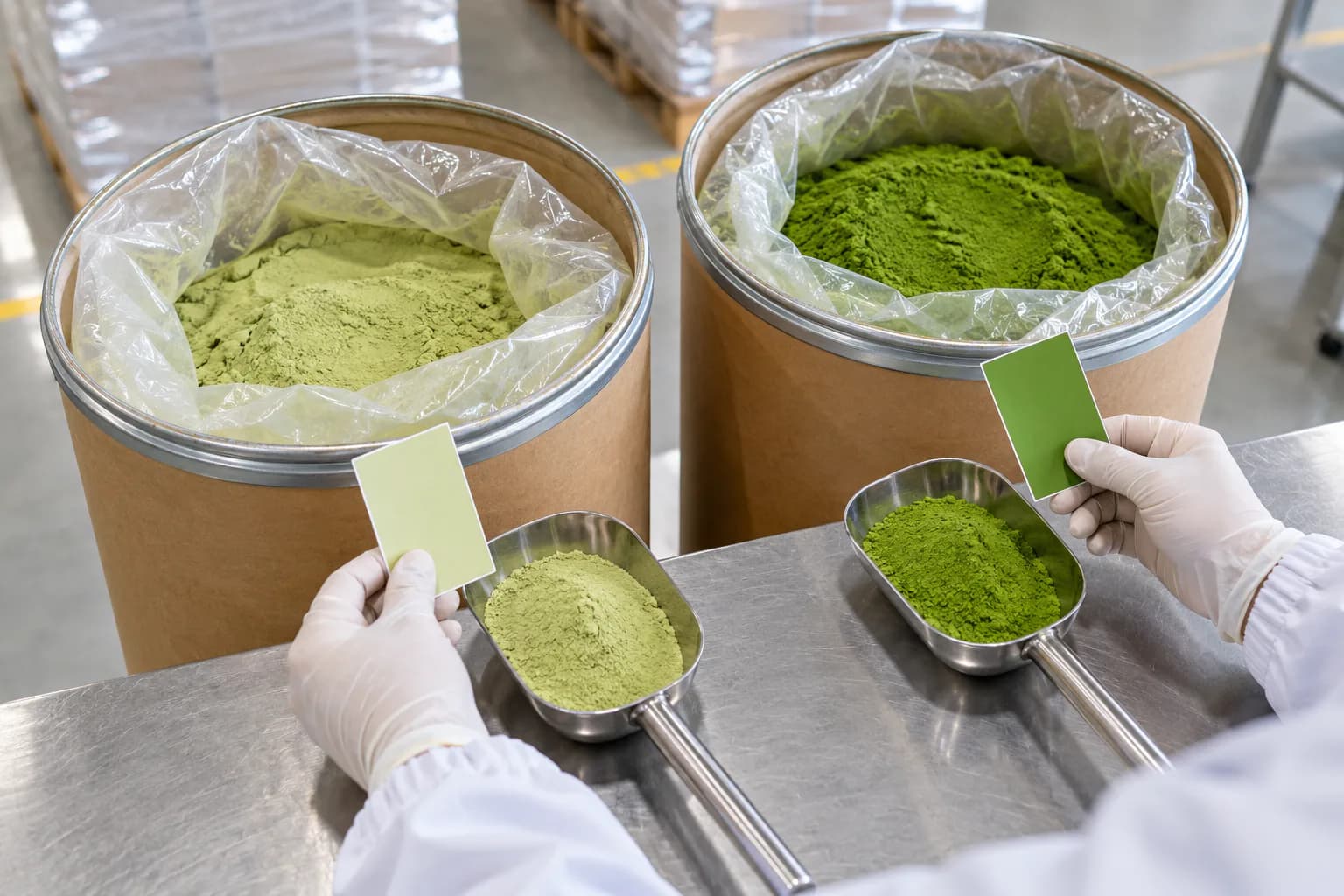
4. Observe the actual feed path
Document loading, hopper wall behavior, outlet discharge, auger or feeder performance and residual powder. Avoid unsafe manual intervention in moving equipment. Follow the equipment maker’s procedures and site safety controls.
5. Check dosing by mass
Even when the feeder is volumetric, collect and weigh repeated doses. Track average, spread and any drift as the hopper level changes. A feeder setting developed for one powder should not be assumed valid for another.
6. Evaluate the complete blend
If tea powder enters a premix, study the blend as well as the ingredient. Differences in particle size and density can affect segregation during transfer and vibration. Sampling design should match the decision being made.
7. Include clean-down and changeover
Record residual material, access points and the time and method required for cleaning under approved site procedures. Cleanability is part of operability even when dosing accuracy is good.
Common interpretation errors
Treating a typical value as a guarantee
A typical value describes information, not necessarily a contractual limit. If the process needs a controlled range, agree on method, sampling and acceptance terms through the appropriate quality and commercial process.
Changing the sample condition
Humidity exposure, temperature and consolidation can affect handling. Keep containers closed when required, record conditioning and compare samples under consistent conditions.
Solving poor flow only with vibration
Vibration can sometimes help or worsen consolidation depending on powder and equipment. It should be tested within equipment and safety guidance, not applied as a universal fix.
Using volume to control a mass-based formula
Volumetric dosing depends on bulk behavior. If product composition is controlled by mass, verify mass delivery and recalibrate when material or conditions change.
Calling dust a product defect
Dust generation depends on material, drop height, transfer energy and extraction. Describe the observation and investigate the system. Occupational exposure controls require qualified site assessment.
Sampling and transport can change the answer
A small scoop from the top of a bag may not represent the material that a feeder sees through an entire run. Powder can settle during transport, and vibration can change packing without changing ingredient identity. Develop a sampling approach that matches the decision, preserves traceability and avoids unsafe access to bulk containers.
When comparing lots, use the same sampling location and conditioning procedure where practical. Record whether the container was newly opened, partly used or transferred. Avoid shaking one sample and not another. If the test requires a representative composite, define how increments are taken and combined through the responsible quality process.
Retained samples should be stored in a way that protects their relevance. A poorly sealed jar exposed to humidity may no longer represent the received material. Record container, storage condition and test date so later results can be interpreted honestly.

Connect laboratory data to equipment design
Bulk-density data can support preliminary volume and refill calculations, but engineering design also needs flow under consolidation, outlet geometry, wall friction, aeration and feeder characteristics. Those properties cannot be replaced by one loose-density result. Consult the equipment supplier or a qualified powder-handling specialist when design consequences are material.
For commissioning, define a challenge range rather than testing only one ideal condition. Consider normal hopper levels, planned throughput, start-stop operation and the permitted environmental range. Keep safety guards and dust controls in place; never reach into operating equipment to break a bridge or collect a sample.
If a commercial process is sensitive to bulk behavior, change control matters. A revised ingredient, manufacturing route or particle profile may require review even when sensory evaluation is acceptable. The supplier and buyer should agree what information is relevant and how changes are communicated without assuming that every physical variation is automatically critical.
Create a fit-for-purpose specification
A useful specification names the characteristic, method, unit, sample preparation and acceptance basis. It also explains why the range matters. Limits copied from another product or equipment line may be unnecessarily narrow or fail to protect the actual process.
Before contracting a range, collect enough representative data to understand method repeatability and lot variation. Decide whether incoming testing, supplier certificates, periodic verification or process monitoring will provide control. These are quality-system decisions, not conclusions that can be drawn from a single article or sample.
Procurement questions
- Which bulk-density method and unit are used?
- Are both free-flow and compacted values available?
- Is the reported value typical, lot-specific or a specification limit?
- What sample conditioning and repeatability information is available?
- What storage instructions apply?
- Has the buyer defined the intended feeder, packer or blender trial?
- How will material changes be communicated under an agreed process?
Frequently asked questions
What is the difference between free-flow and compacted bulk density?
Free-flow density measures powder placed into a known volume under a defined pouring method. Compacted density measures volume after a defined tapping procedure. The difference helps describe settling under those test conditions.
Does higher bulk density mean better instant tea powder?
No. It describes physical packing behavior, not flavor, composition or overall quality. The useful range depends on packaging and process needs.
Can bulk density predict package size?
It can support an estimate, but actual filling, aeration, settling, headspace and tolerances must be considered. Confirm with packaging trials.
Can a volumetric feeder be used?
Possibly, but mass output must be checked repeatedly for the named powder and operating range. Gravimetric control may be preferred where mass accuracy is critical.
Is ISO 6770 still current?
ISO’s catalogue states that ISO 6770:1982 was reviewed and confirmed in 2025. Users should still verify the current edition and contractual applicability before use.
Conclusion
Bulk density and flowability are process-fit characteristics. Define the equipment question, compare method-aligned data, preserve sample conditioning and validate repeated mass delivery in the intended system. The strongest specification is one connected to a reproducible method and a real operational need.