Introduction
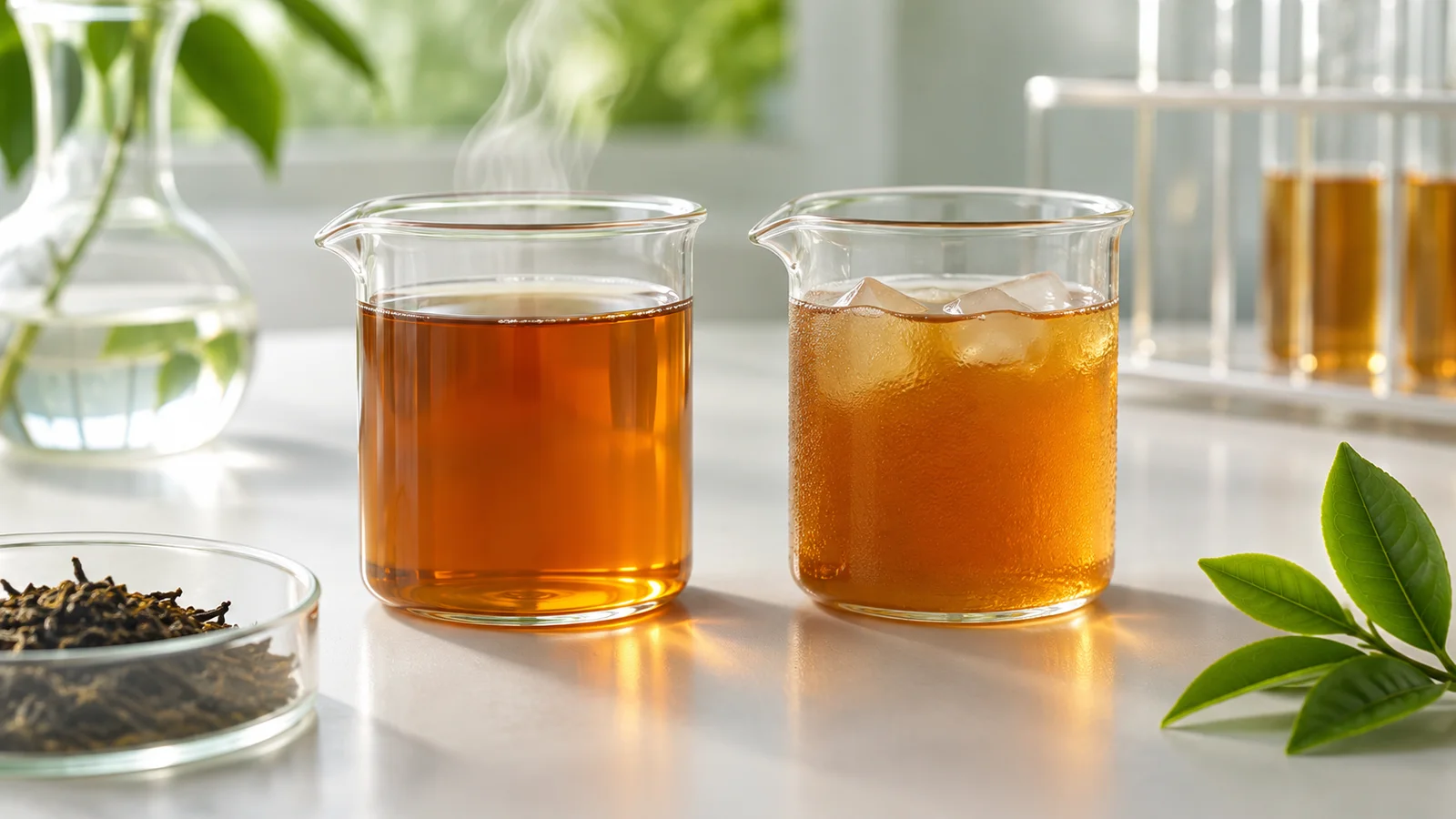
An RTD tea can look clear immediately after preparation and become hazy after cooling or storage. One possible mechanism is tea cream: a finely divided association of tea components that becomes less soluble as conditions change. It is not the same question as whether dry powder initially disperses, and it should not automatically be described as contamination, spoilage or a supplier defect.
Short answer: Evaluate tea cream and haze by fixing the formula and process, then measuring appearance across temperature, time and package conditions. Compare a warm reference with cooled samples, record turbidity or transmittance where useful, and investigate ingredient concentration, tea composition, minerals, pH and other formula components. The acceptable result depends on the intended product appearance.
This article provides general education. It does not describe a Healsun incident, customer project or guaranteed formulation outcome.
What is tea cream?
Tea cream is the suspended or precipitated material that can form when a tea infusion cools. Research on black tea associates the phenomenon with interactions among polyphenolic compounds, caffeine and other constituents. Research on green tea also identifies several interacting component groups, reinforcing that one simple cause cannot explain every tea system.
The practical lesson is not that a named tea powder will always haze. It is that clarity belongs to the complete beverage system. Tea type, solids concentration, water, sweeteners, acids, proteins, process history, temperature and storage can change what is visible.
Tea cream, sediment and surface film are different observations
Use neutral descriptions before assigning a cause:
| Observation | Useful first description | Questions to investigate |
|---|---|---|
| Uniform cloudiness after cooling | cold haze or turbidity | Is it reversible on warming? Does it change with temperature or time? |
| Material collecting at the bottom | sediment or precipitate | Does it redisperse? What is the particle source and size? |
| Ring at the package wall | adhesion or deposit | Is it linked to fill level, package surface or storage orientation? |
| Surface layer | film or floating material | Is it formula-derived, process-derived or environmental? |
| Immediate undissolved particles | incomplete dissolution or dispersion | Were mixing time, temperature and order controlled? |
These labels are observations, not diagnoses. A laboratory investigation may be needed when the decision affects product safety, compliance or release.
Why haze can appear only after cooling
Temperature changes solubility and molecular association. Published black-tea work reports that higher tea concentration can advance the onset of creaming and that theaflavin, caffeine and calcium can influence association. A 2023 green-tea study described a more complex colloidal system involving polysaccharides, proteins, EGCG and caffeine. These studies explain mechanisms under their own conditions; they do not establish universal commercial limits.
For product developers, a hot-cup check is therefore incomplete. A beverage intended for chilled distribution should be observed after realistic cooling and storage, not only while warm and freshly mixed.
Variables to control in a bench study
Tea identity and dosage
Record the exact ingredient, sample or lot identifier and addition rate. A concentration series can show whether appearance changes gradually or crosses a practical threshold. Do not compare products at different dosages without stating whether the comparison is equal mass, equal tea solids or equal sensory intensity.
Water and minerals
Use one characterized water source for the main comparison. Calcium and other minerals can affect tea systems, but a general mechanism does not predict a specific finished beverage. If the commercial plant uses a different water source, include it as a planned variable rather than changing water unnoticed between trials.
pH and acidification sequence
Measure pH with calibrated equipment and record the acid type, quantity and addition sequence. If acid is part of the formula, compare one controlled sequence at a time. Avoid interpreting pH alone as a complete stability explanation because buffering and ingredient interactions also matter.
Sweeteners and other ingredients
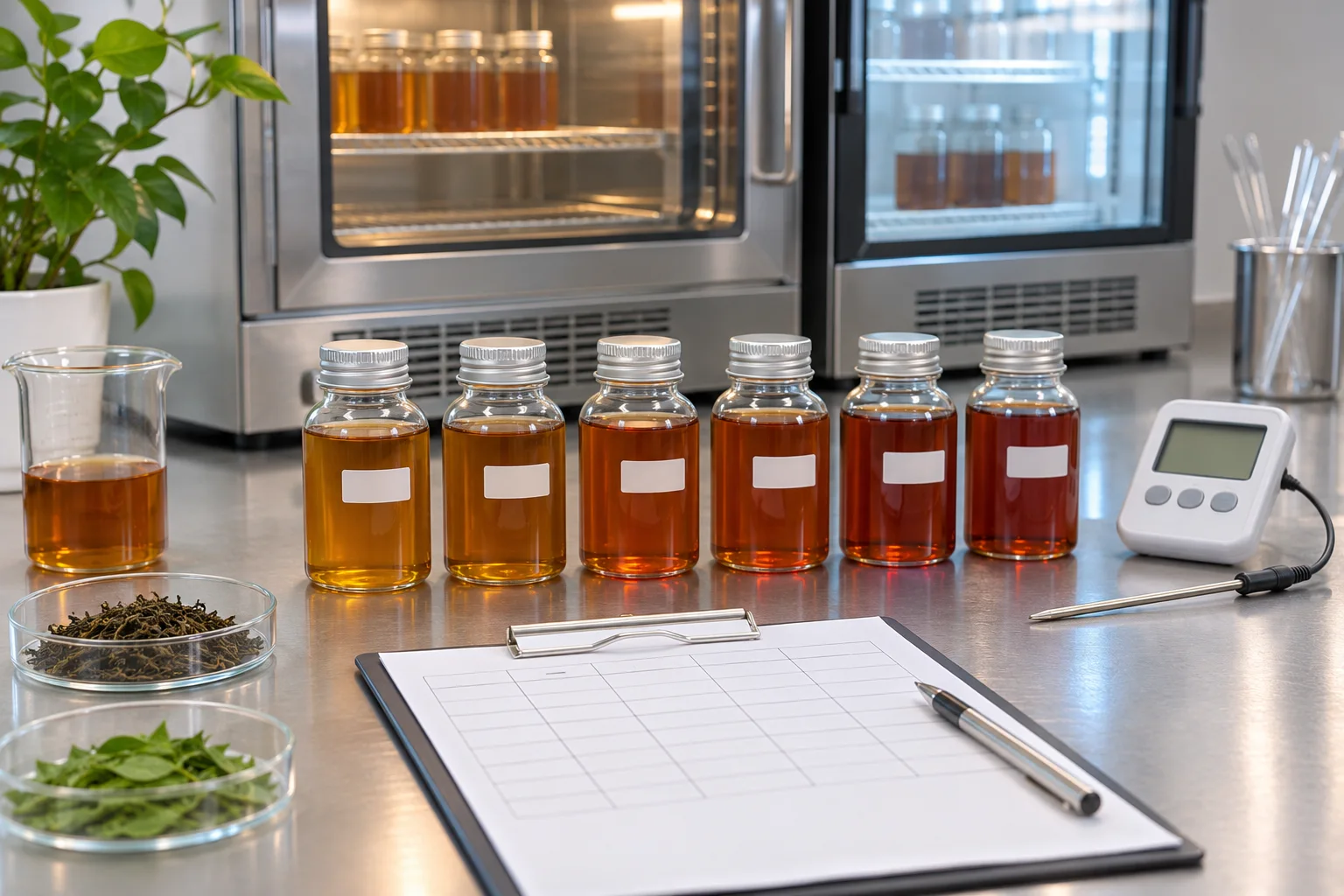
Sugar, high-intensity sweeteners, flavors, juice, proteins and hydrocolloids can change the matrix. Start with a simple control and add components systematically. This is more informative than changing several ingredients in one rescue trial.
Heat, cooling and holding
Record actual product temperature and time, not only equipment settings. Compare like-for-like samples before and after the intended thermal step. Control cooling rate when it is relevant to the commercial process.
Package and storage
Package geometry, headspace, light and storage temperature may alter appearance or its visibility. Use the intended package when possible and include an analytical container only as a controlled reference.
A practical tea-haze test workflow
- Define the visual target. State whether the product should be brilliant, acceptably clear, naturally cloudy or opaque.
- Prepare a fixed control. Lock water, tea addition, mixing, pH, heat and fill conditions.
- Create one-variable variants. Change dosage, water, pH or another factor in a documented series.
- Capture a warm baseline. Record temperature, photograph under fixed lighting and measure turbidity or transmittance if the project uses instrumentation.
- Cool consistently. Use the same cooling method and observation times.
- Inspect without disturbing. Record uniform haze, flakes, sediment, rings and surface material separately.
- Test reversibility where appropriate. A controlled warming observation can help distinguish temperature-linked association, but it is not a release test by itself.
- Continue through storage. Use a qualified shelf-life protocol designed for the actual product and market.
- Confirm the winning formula at relevant scale. Bench appearance cannot prove commercial mixing, thermal or filling performance.
How to record results without overclaiming
A useful record connects sample identity, recipe, process and observation. Include preparation date, operator, water source, ingredient lots, weights, pH, temperature history, package, storage condition and observation time. Use a fixed photo background and lighting. If using a turbidity meter or spectrophotometer, record instrument, method and units.
Avoid writing “stable” after one clear photograph. A better statement is: “No visible haze was observed under the recorded conditions at the stated observation time.” That language is narrower, reproducible and less likely to be mistaken for a shelf-life guarantee.
Design an appearance specification that can be repeated
An appearance requirement is useful only when another team can reproduce it. “Clear” may mean brilliant transparency to one reviewer and merely no visible flakes to another. Define the sample preparation, tea concentration, water, container, path length, observation temperature, rest time and lighting. If an instrument is used, identify the method, wavelength or turbidity unit and sample handling.
Separate ingredient screening from finished-product release. An ingredient-screening method may use a simple standardized liquor to compare candidates. A finished-product method should use the complete formula and relevant process. The two methods can support each other, but their results should not be presented as interchangeable.
Set a review zone as well as a pass/fail rule when appropriate. A borderline result may justify repetition, method review or a retained-sample comparison rather than immediate rejection. The responsible quality team should approve the final sampling and acceptance plan.
Scale-up questions for pilot and production trials
Bench tests control variables well, while larger systems introduce mixing gradients, different heating and cooling rates, transfer lines, hold vessels and package-filling conditions. Before scale-up, identify which variables are likely to change and decide what evidence will demonstrate equivalence.
At pilot scale, sample at defined points rather than only from one convenient outlet. Record whether the tank was agitated, how long product was held and whether the sample came from start, middle or end of filling. If appearance differs across the run, preserve samples and records for investigation instead of averaging the observation away.
Production confirmation should also distinguish normal variation from a new material effect. Compare against an approved reference made under known conditions where possible. A scale-up result is more credible when ingredient lot, recipe version, water source, process record and package code can be traced together.
Interpreting common outcomes
Clear when warm, hazy when cold
Investigate temperature-linked association, solids level, minerals and formula interactions. Repeat the temperature cycle under controlled conditions before drawing a conclusion.
Haze differs between water sources
Characterize both waters and repeat the trial. The result supports a water–formula interaction hypothesis; it does not by itself identify one mineral as the cause.
Sediment appears immediately
First review dissolution, mixing order, powder addition and other insoluble ingredients. Immediate particles may belong to a different problem than tea cream formed during cooling.
A formula is visually cloudy but tastes acceptable
Return to the product brief. A deliberately cloudy beverage may be commercially acceptable if the appearance is consistent, safe and correctly communicated. Clarity is a design requirement, not a universal quality ranking.
Procurement questions
- What exact tea format and sample identity are being offered?
- What preparation conditions are recommended for evaluation?
- Which physical appearance information is available for the named product?
- Are clarity or solubility values method-defined or only descriptive?
- Which storage and handling instructions apply?
- How will an approved sample be linked to commercial material?
- Which formula and package conditions must the buyer validate independently?
Frequently asked questions
Is tea cream the same as microbial spoilage?
No. Tea cream describes a physicochemical association of tea components, while spoilage is a separate safety and quality question. Visual inspection alone cannot rule in or rule out a microbiological issue; use an appropriate investigation and qualified testing when safety is in question.
Does tea cream mean the tea powder is defective?
Not necessarily. Tea cream can depend on the complete formula, concentration, water, temperature and process. Compare controlled samples and agreed specifications before attributing an outcome to one ingredient.
Can filtration solve RTD tea haze?
Filtration may change particles under defined conditions, but it can also affect composition, sensory profile and process economics. It should be evaluated as part of a validated process, not presented as a universal correction.
Should a buyer specify turbidity?
Only when the method, temperature, timing and acceptance purpose are clear. A number without preparation and measurement conditions is difficult to reproduce.
Can tea cream appear in green or oolong tea?
Cream-like colloidal association has been studied in multiple tea types. The composition and behavior can differ, so product-specific testing is still required.
Conclusion
Tea cream and cold haze are best managed as controlled beverage-development questions. Define the appearance target, separate observations from causes, hold the recipe and process constant, and track appearance through realistic temperature and storage conditions. Evidence from one bench cup should guide the next test, not become a universal claim.