Introduction
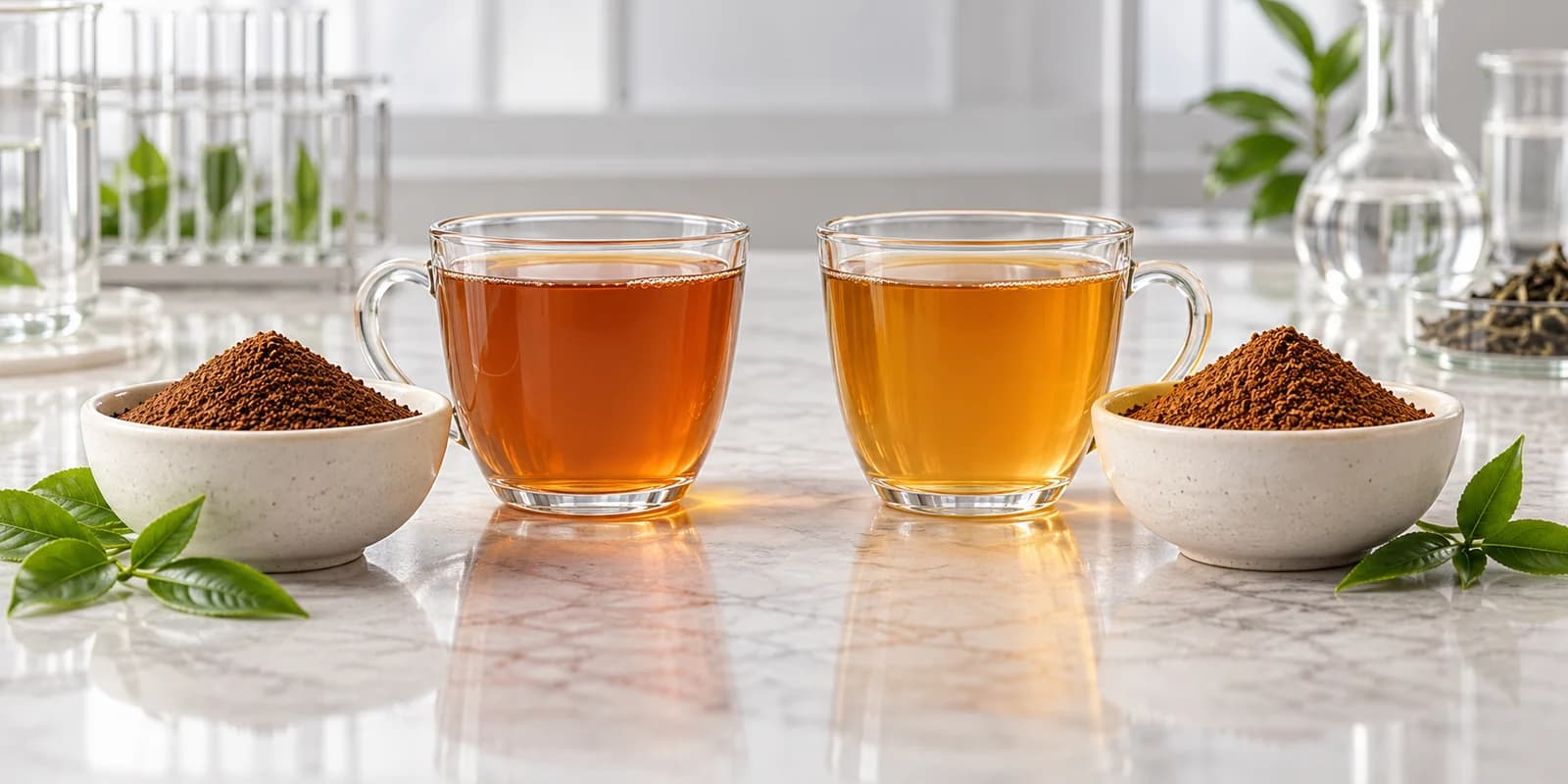
A dry tea drink mix must work twice: first as a powder during weighing, blending, transfer and packing, then as a beverage when the user adds liquid. These are connected but different performance problems. A powder that tastes right in a hand-prepared cup may not distribute evenly through a multi-ingredient blend. A uniform premix may still wet slowly, foam excessively or leave residue under the intended consumer preparation method.
The development task is therefore broader than finding an instant tea powder that “dissolves well.” The team needs to define ingredient identity, particle and bulk behavior, addition sequence, blend-uniformity evidence, reconstitution conditions, sensory targets and packaging protection. Each stage should be tested with the complete formulation and the real process concept.
Short answer: Instant tea powder can be used in sachets, stick packs, jars and foodservice dry beverage mixes, but performance depends on the whole blend. Buyers should evaluate flow and segregation risk during handling, sample the blend at defined locations, reconstitute it with a consumer-relevant method, and test the intended package under controlled storage conditions.
This article provides a general educational framework. It does not specify a formula, processing limit, shelf life or commercial specification for any Healsun product.
Why a dry mix behaves differently from tea powder alone
Instant tea powder is only one particulate component in a dry beverage system. The finished mix may include sugar, acids, flavors, dairy or plant ingredients, minerals, colors, sweeteners and other permitted components. These materials can differ in particle size, shape, density, surface properties and moisture sensitivity.
When dissimilar powders are combined, movement can change their distribution. Fine particles may move through spaces between larger particles. Light particles may be carried by air during transfer. Particles may roll differently on a heap or adhere to equipment surfaces. A blend that appears homogeneous immediately after mixing can become less uniform after discharge, conveying, vibration or packing.
This does not mean that every dry tea mix will segregate. It means uniformity cannot be inferred from mixer time alone. The actual ingredients, equipment and handling path determine the risk.
Flowability is a system response
Powder flow is not one fixed property that belongs to an ingredient under all conditions. It is influenced by particle size distribution, shape, moisture, interparticle forces, consolidation, equipment surfaces and the stress applied during handling. A bench observation such as “free flowing” is useful only when the method and conditions are recorded.
Simple indices based on bulk and tapped density may help compare samples, while shear-cell or other dynamic methods can better represent some process conditions. The appropriate method depends on the decisions being made. A procurement team should ask its manufacturing and quality colleagues which measurements correlate with hopper discharge, feeder performance or packing consistency in their facility.
Reconstitution includes more than dissolution
Reconstitution can involve several stages: liquid penetration, wetting, sinking, dispersion of agglomerates and dissolution of soluble solids. A mix can form floating islands before eventually dissolving. It can dissolve chemically yet produce excessive foam, wall residue or flavor nonuniformity because the preparation method is unsuitable.
For this reason, record time-dependent observations instead of assigning a single “soluble” or “insoluble” label. Define the liquid, temperature, dose, vessel, mixing tool and number or duration of mixing actions.
Start with a dry-mix product brief
Before requesting samples, describe the finished product rather than asking only for a tea type. A useful brief includes:
- intended format: single-serve sachet, stick pack, jar, vending mix or foodservice bag;
- serving size and preparation volume;
- hot, ambient or cold reconstitution concept;
- water, milk or plant-based liquid as the preparation medium;
- tea type and intended sensory direction;
- whether the formula contains sugar, acid, protein, minerals or other major components;
- consumer mixing method, such as spoon, shaker or dispensing machine;
- manufacturing equipment and batch scale available;
- packaging concept and distribution environment;
- relevant destination market and document questions; and
- decision criteria for the first sample screen.
Do not assume that “instant” means instant under every consumer condition. A powder developed for hot water may behave differently in cold milk. A concentrated foodservice dose may require different mixing energy from a light single-serve drink.
Confirm what the tea ingredient is
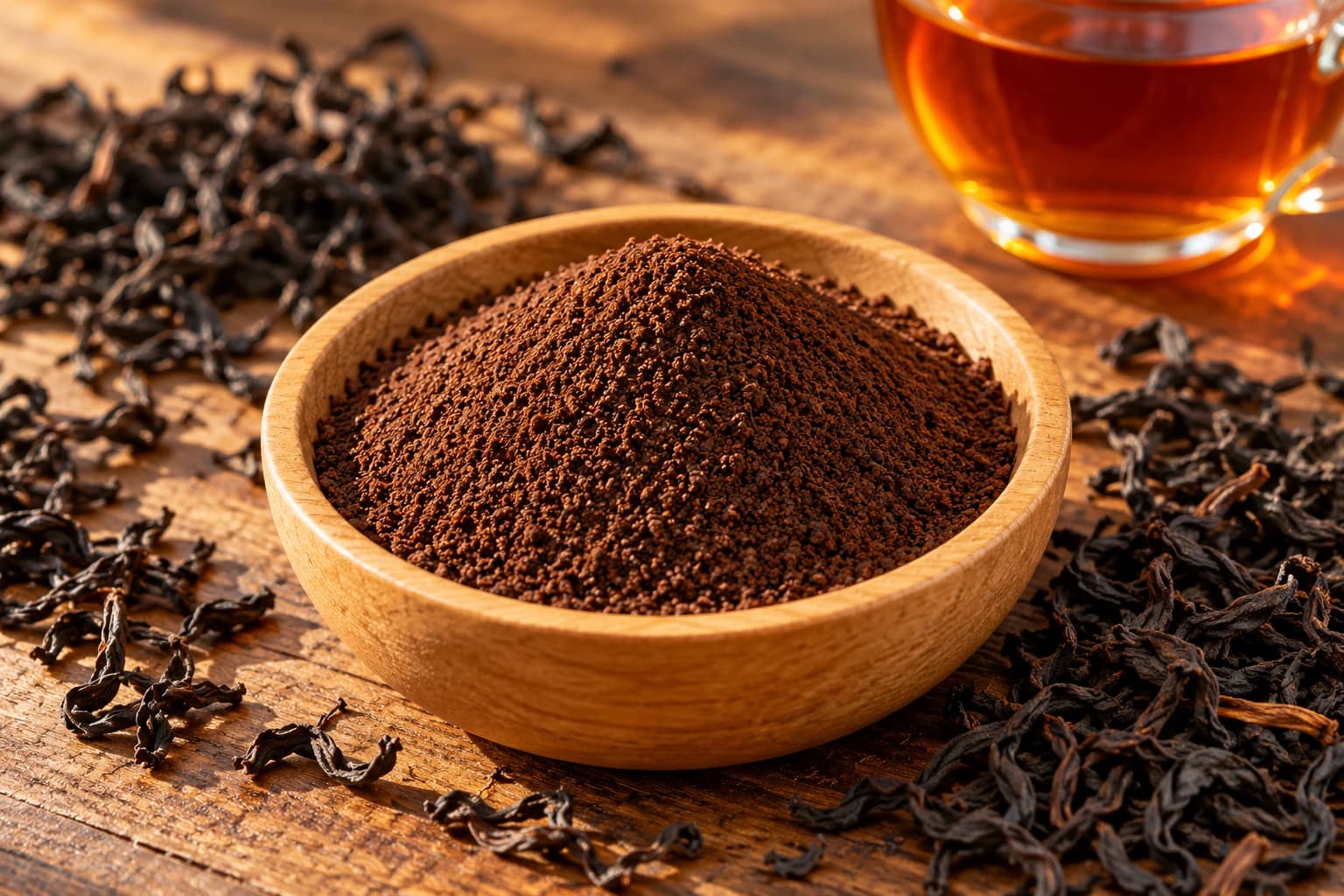
ISO 6079 covers instant tea in solid form within a defined scope, but commercial terms are still used inconsistently. Confirm whether the selected material is a soluble instant tea powder, a milled whole-leaf powder or a formulated tea-containing preparation. Request the product-specific identity and composition information available for the exact sample.
The distinction matters because a whole-leaf powder creates a suspension, while an instant extract is selected for dissolution. Neither format is automatically better; they answer different product concepts.
Screen the tea ingredient before building the full blend
Begin with the named tea sample and a controlled preparation. The purpose is to establish a baseline, not to approve the finished product.
Record:
- sample code and supplied product identity;
- dry appearance and odor under consistent conditions;
- bulk handling observations using the facility’s method;
- the amount and liquid used for reconstitution;
- liquid temperature at the start;
- mixing device, speed or number of strokes;
- time to visual uniformity;
- foam, wall adhesion and bottom residue;
- beverage color, aroma, flavor and mouthfeel; and
- changes after a defined standing period.
Use a representative dose. An unrealistically low concentration can make every candidate look easy to dissolve, while an extreme concentration may reject materials that would work at the actual serving level.
Design the blend trial around segregation risk
Compare ingredient distributions before choosing a mixing sequence
Particle size alone does not predict segregation, but large differences in size, density and shape can create risk. Review the complete formulation. Note very fine minor components, large sugar crystals, low-density flavors and cohesive powders. Consider how each component is introduced and whether a preblend is appropriate for low-dose ingredients.
A preblend can improve the distribution of a small component by first combining it with a compatible portion of a larger component. However, a generic preblend rule should not replace process development. The ratio, order and mixing method must suit the actual materials.

Use a documented order of addition
Write the intended sequence before the trial. Record actual additions and any material retained on bags, scoops, vessel walls or filters. If the tea powder is added too early or too late without a rationale, it may experience a different mixing history from the rest of the blend.
Changing order, mixer load, speed and time simultaneously prevents useful interpretation. Run a small designed set of trials in which one or a few justified variables change.
Do not equate longer mixing with better mixing
Mixing can reduce distributional differences, but extended movement can also permit a blend to separate under some conditions. The endpoint must be supported by samples, not by an assumption that additional minutes always help.
At pilot scale, collect samples using a written plan that identifies location and time. The number and size of samples should be determined by the quality team and the analytical method. A single scoop from the top of a mixer cannot represent an entire batch.
Include transfer and packing in the assessment
The blend’s journey after the mixer matters. Discharge into a bin, pneumatic or mechanical conveying, hopper residence, vibration and repeated start–stop filling can change particle distribution. Take samples at meaningful stages when technically and operationally appropriate.
For single-serve formats, compare early, middle and late packed units. For a jar, consider whether normal distribution vibration could change the blend and whether the user’s scooping method is expected to deliver a consistent serving. These questions need a product-specific test, not a visual judgment.
A practical reconstitution test for the finished mix
The finished mix should be evaluated using the conditions expected in the market. A laboratory high-shear mixer may be valuable for formulation work but may hide a poor consumer experience if the label calls for stirring with a spoon.
Define the standard method
Specify:
- mass of dry mix;
- liquid type and volume;
- starting liquid temperature;
- vessel dimensions;
- addition direction, such as powder into liquid;
- mixing tool and action;
- mixing time or number of strokes;
- observation times; and
- serving temperature for sensory evaluation.
Prepare multiple units from different positions in the pilot batch. This links beverage performance with blend uniformity rather than testing only one ideal laboratory portion.
Observe the full reconstitution sequence
At fixed time points, note whether the powder floats, sinks, forms dry-centered agglomerates or adheres to the vessel. Record the disappearance of visible particles, foam height or persistence where relevant, and residue on the wall and bottom.
For instant tea, distinguish tea-related behavior from other components. Sugar crystals, proteins, gums and flavors can dominate the visual result. A control blend without tea or a component-by-component comparison may help during troubleshooting.
Evaluate the beverage, not just the beaker
Once prepared, assess aroma, tea intensity, sweetness, acidity, bitterness, astringency, mouthfeel and aftertaste using a defined vocabulary. Test at the intended serving temperature; hot samples can suppress or accentuate different attributes compared with cooled samples.
If the mix is intended for milk or a plant-based liquid, test that medium rather than extrapolating from water. State the specific base used because different commercial bases can produce different results.
Moisture, packaging and storage questions
Food powders can absorb moisture when the package does not provide adequate protection or when package integrity is compromised. Moisture uptake can increase cohesion and contribute to caking. The degree of sensitivity varies with formulation and environmental conditions, so the finished blend—not only the tea ingredient—requires evaluation.
Test the proposed pack, not a convenient substitute
A sealed laboratory jar can protect a mix differently from a thin trial pouch or a repeatedly opened foodservice bag. Once the formula and format are sufficiently developed, use representative packaging materials, sealing conditions and fill quantities.
Record pack construction, seal settings, headspace approach and any desiccant or other component only where permitted and technically justified. Do not claim a barrier property from appearance; rely on supplier data and appropriate verification.
Consider the distribution environment
Temperature and humidity cycles, vibration and compression can affect powder condition and blend distribution. A storage program should reflect intended markets and routes, but accelerated conditions require expert design and interpretation. Severe conditions can reveal sensitivity without directly predicting real-time shelf life.
Define opening and use conditions
A multi-serve jar or foodservice bag experiences repeated opening and utensil contact. Evaluate instructions, closure performance and realistic handling. Single-serve packs avoid repeated opening but add their own fill-weight, seal-integrity and unit-to-unit uniformity questions.
Commercial shelf life must be supported by the manufacturer’s complete stability and safety program. A few weeks without visible caking is not adequate evidence for a shelf-life claim.

Troubleshooting by symptom
| Observation | Questions to investigate | What not to conclude immediately |
|---|---|---|
| Tea color varies between prepared units | Were units sampled across the batch and packing run? Is fill mass consistent? Could segregation or dosing variation be involved? | That the tea powder itself changed between servings |
| Powder floats and forms dry lumps | What are liquid temperature, addition direction, surface-active ingredients and consumer mixing action? | That all “instant” tea should sink immediately in every formula |
| Blend cakes during storage | Did moisture enter? Was the pack representative and intact? What are the formula’s moisture sorption characteristics? | That one component alone caused the change |
| Mixer sample is uniform but packed units vary | What happened during discharge, transfer, hopper residence and filling? | That longer mixer time is necessarily the solution |
| Beverage tastes weaker late in a packing run | Are tea solids or another flavor component distributed differently? Are fill weights and preparation controlled? | That flavor perception proves a quantitative composition difference |
| Residue remains after stirring | Is it undissolved tea, another ingredient or an intentionally insoluble component? | That visible material automatically makes the drink unsafe |
Troubleshooting should follow evidence. Repeat the preparation, verify scales and methods, inspect the process record and use an appropriate analytical test before changing the formula.
From sample approval to a purchase discussion
Once a candidate passes the application screen, connect the result to a named product and a controlled sample. Procurement should confirm the information needed for its approval system.
Ask about:
- precise product identity and tea type;
- product-specific specification and sample reference;
- available composition or ingredient information;
- proposed packing and storage instructions;
- lot traceability and document availability;
- the process for discussing a commercial sample or order;
- destination-market questions that require buyer review; and
- change communication expectations.
Do not infer MOQ, price, production capacity, lead time, origin, certification scope or regulatory suitability from a general article. Those points require current, product-specific confirmation.
Frequently asked questions
Is instant tea powder suitable for stick packs?
It can be, provided the selected tea and complete blend meet the project’s requirements for flow, fill consistency, reconstitution, sensory quality and package stability. Suitability should be demonstrated with representative equipment and packaging rather than assumed from a cup test.
How can a developer prevent tea powder from separating in a dry blend?
There is no single preventive step. Review particle and bulk properties, ingredient proportions, order of addition, preblending, mixer operation, transfer and packing. Sample the blend at defined points to determine whether distribution remains acceptable.
Does a finer tea powder always mix more uniformly?
No. Fine particles may be cohesive, airborne or prone to adhering to larger particles and equipment. Particle size interacts with density, shape, surface properties and process conditions. Test the actual materials.
What is the difference between dispersibility and solubility in a drink mix?
Dispersibility describes how the powder distributes through the liquid, while solubility concerns the portion that dissolves at the molecular level. A soluble ingredient can still wet slowly or form temporary agglomerates, and an insoluble leaf powder can disperse uniformly as a suspension.
Can cold-water performance be predicted from a hot-water test?
Not reliably. Temperature affects wetting, dissolution, viscosity and flavor perception. If cold preparation is part of the product promise, use the intended water temperature and consumer mixing method in the test.
How should blend uniformity be tested?
Use a written sampling plan and an analytical marker appropriate to the formulation and decision. Sample locations, timing, quantity and method should be established by qualified quality or process specialists. Visual color alone may be insufficient.
How should packaging be selected for a tea drink mix?
Selection should consider the finished formula’s moisture and oxygen sensitivity, serving format, seal process, distribution environment and opening pattern. Supplier barrier data and representative pack testing are more useful than choosing by material name alone.
Can one successful pilot establish shelf life?
No. A pilot demonstrates process and application feasibility under its recorded conditions. Shelf life requires a separate program addressing the finished formulation, package, production controls, storage conditions, microbiological considerations and applicable market requirements.
Conclusion
Instant tea powder for dry drink mixes should be selected as part of a complete powder-and-beverage system. Define the consumer preparation first, confirm the tea format, then examine flow and blending through the real handling path. Sample the pilot blend at meaningful points, reconstitute units with the intended method and evaluate the proposed package under a qualified program.
This evidence-based workflow helps teams avoid two common errors: approving a tea from a perfect laboratory cup while ignoring dry-blend behavior, or optimizing powder flow while overlooking the beverage the customer actually prepares.
Educational disclaimer
This article is general educational information only and is not purchasing, commercial, legal, regulatory, food-safety, nutritional or technical decision advice. It does not describe a Healsun production line, customer formula, failed batch, shipment event or guaranteed product result. All formulas, process parameters, specifications, documents, packaging, stability and destination-market requirements must be established and verified for the named product and project by qualified parties.
References
- ISO 6079:2021 — Instant tea in solid form — Specification
- A Comprehensive Review of the Rehydration of Instant Powders
- A concise summary of powder processing methodologies for flow enhancement
- Blend Segregation in Tablets Manufacturing and Its Effect on Drug Content Uniformity
- The influence of operational parameters and feed preparation in a convective batch ribbon powder mixer
- FAO: Fruit and vegetable processing — deterioration factors and their control