Introduction
“Tea powder” and “tea flavor” can both appear in a product-development brief, but they are not interchangeable purchasing descriptions. One may be a soluble tea extract intended to deliver tea solids and characteristic taste. The other may be a flavoring preparation designed mainly to impart or modify aroma and taste. A finished product may use one, the other, or both, depending on its identity, sensory target, process and market requirements.
Short answer: Choose instant tea powder when the brief requires a reconstitutable tea ingredient and the associated body, color, bitterness or astringency fits the product. Consider a tea flavor when the main objective is a defined aroma or flavor note and the flavoring's composition, carrier, use conditions and labeling are acceptable. Do not choose from the sales name alone: request the exact product identity and test it in the complete formula.
This guide is educational, not a labeling opinion or a statement that a particular Healsun product is available. Ingredient declarations and claims must be reviewed for the destination market by qualified specialists.
What is instant tea powder?
ISO 6079:2021 specifies requirements for instant tea in solid form within a stated scope. Its exclusions are important: the standard does not cover every powder marketed with a tea-related name. For example, its scope excludes filled instant tea containing non-tea carbohydrates as bulking or filling agents, certain preparations with added aromatic material, decaffeinated instant tea and products derived from non-tea infusions.
For a buyer, the practical lesson is not to use “ISO instant tea” as a blanket description. Confirm whether the candidate is a soluble extract from *Camellia sinensis*, whether other materials are present, and which product-specific specification applies.
Instant tea powder can contribute several sensory dimensions at once:
- characteristic tea taste and aroma;
- bitterness and astringency;
- color and soluble solids;
- haze or clarity behavior, depending on the material and formula; and
- response to pH, minerals, heat and storage.
Those effects may be desirable, but they also mean that dosage cannot be selected only by smelling the dry powder.
What is tea flavor?
“Tea flavor” is a commercial description, not one globally uniform composition. A flavor may contain flavoring substances or preparations, carriers and other permitted components. Definitions and labeling rules vary by jurisdiction.
In the United States, 21 CFR 101.22 defines natural flavor by source and function: its significant function in food is flavoring rather than nutritional. In the European Union, Regulation (EC) No 1334/2008 defines flavorings as products not intended to be consumed as such and added to impart or modify odor or taste, with several categories and specific rules for use of “natural.” These examples show why a buyer should not transfer a label conclusion from one market to another.
A tea flavor may be liquid or dry and may be designed for a specific matrix, process or aroma direction. Its source description, carrier, solubility and declaration need product-specific confirmation. “Natural,” “tea-derived,” “tea type” and “flavored” should never be assumed from an informal sample name.
The core difference: ingredient identity and function
| Decision area | Instant tea powder | Tea flavor |
|---|---|---|
| Primary commercial role | Reconstitutable tea ingredient within the named product's definition | Impart or modify aroma and/or taste |
| Typical sensory contribution | Tea taste, aroma, color, bitterness, astringency and soluble solids | Targeted aroma/flavor profile; other effects depend on composition and carrier |
| Physical form | Dry soluble extract powder within product-specific scope | Liquid or dry flavor system |
| Composition question | Tea source, extraction, added materials and specification | Flavor category, source, carrier, additives and declaration |
| Application risk | Haze, sediment, color or taste imbalance | Volatility, carrier compatibility, flavor fade or labeling mismatch |
| Approval evidence | Sample identity, specification, application trial and lot records | Flavor documentation, application trial, market-specific regulatory review |
This table is directional. A named product may not fit every generalization, so the supplier's documentation remains decisive.
When instant tea powder may fit better
Instant tea powder is often the more aligned starting point when the product concept depends on recognizable brewed-tea character rather than aroma alone. Examples include an RTD tea, tea latte, powdered tea drink or food in which tea color and taste are part of the intended identity.
It may also help when the development team wants to compare tea types or extraction profiles as ingredients. However, a stronger tea identity can bring more bitterness, astringency or color than the formula can support. Selecting a powder is therefore a balance across sensory intensity, physical behavior and process fit—not a search for the strongest sample.
When tea flavor may fit better
A flavor may be considered when the product needs a particular top note, when the base matrix masks tea aroma, or when low addition mass is operationally important. It may also be used to restore an aroma direction that changes during heat or storage.
That does not make flavor a universal shortcut. A flavor may not provide the color, body or complete taste architecture associated with tea solids. Its carrier may behave differently in water, fat, alcohol or a dry premix. Thermal and storage performance must be evaluated in the real process. Most importantly, the finished product's name, ingredient statement and claims need destination-market review.
Why some formulations use both
An instant tea powder and a tea flavor can serve complementary roles: the powder can provide the base tea character, while a flavor may shape a specific aroma note. Whether that combination is appropriate depends on the desired product identity and permitted labeling.
Using both should be an explicit formulation decision. Keep separate sample codes and records so the team knows which material contributes to each change. If tea powder dosage is reduced after flavor addition, reassess taste, color and physical stability rather than approving the aroma alone.
Build a sourcing brief that prevents category errors
Before requesting samples, state:
- finished product and target market;
- expected tea type and sensory vocabulary;
- whether tea solids, tea color or only a flavor note is required;
- clear, cloudy or suspended appearance target;
- water-, dairy-, plant-, fat- or powder-based matrix;
- pH, heat and storage concept where disclosure is permitted;
- liquid or dry ingredient handling constraints;
- labeling and claims questions for specialist review; and
- what evidence will move a sample to the next stage.
Do not write “natural tea flavor required” unless the regulatory and sourcing teams have defined what that phrase must mean in the destination market.
A controlled comparison method
Step 1: Verify identity before opening samples
Record the commercial name, supplier reference, sample or lot identifier, form and documents received. Ask whether the sample is an instant tea powder, a flavoring, a compound preparation or another category. Preserve the original label and link it to internal test codes.
Step 2: Create a fixed base and control
Prepare one formula without tea powder or tea flavor. Use the same water or matrix lot, batch size, equipment and starting temperature. The control shows what the base contributes and prevents a background vanilla, fruit or dairy note from being misread as tea performance.
Step 3: Compare category-appropriate candidates
Do not force equal weight additions and call the result fair. The materials have different functions and use levels. Instead, screen each according to supplied handling guidance and build candidates toward the same sensory brief. Record actual additions and avoid unsupported extrapolation from a supplier's general range.
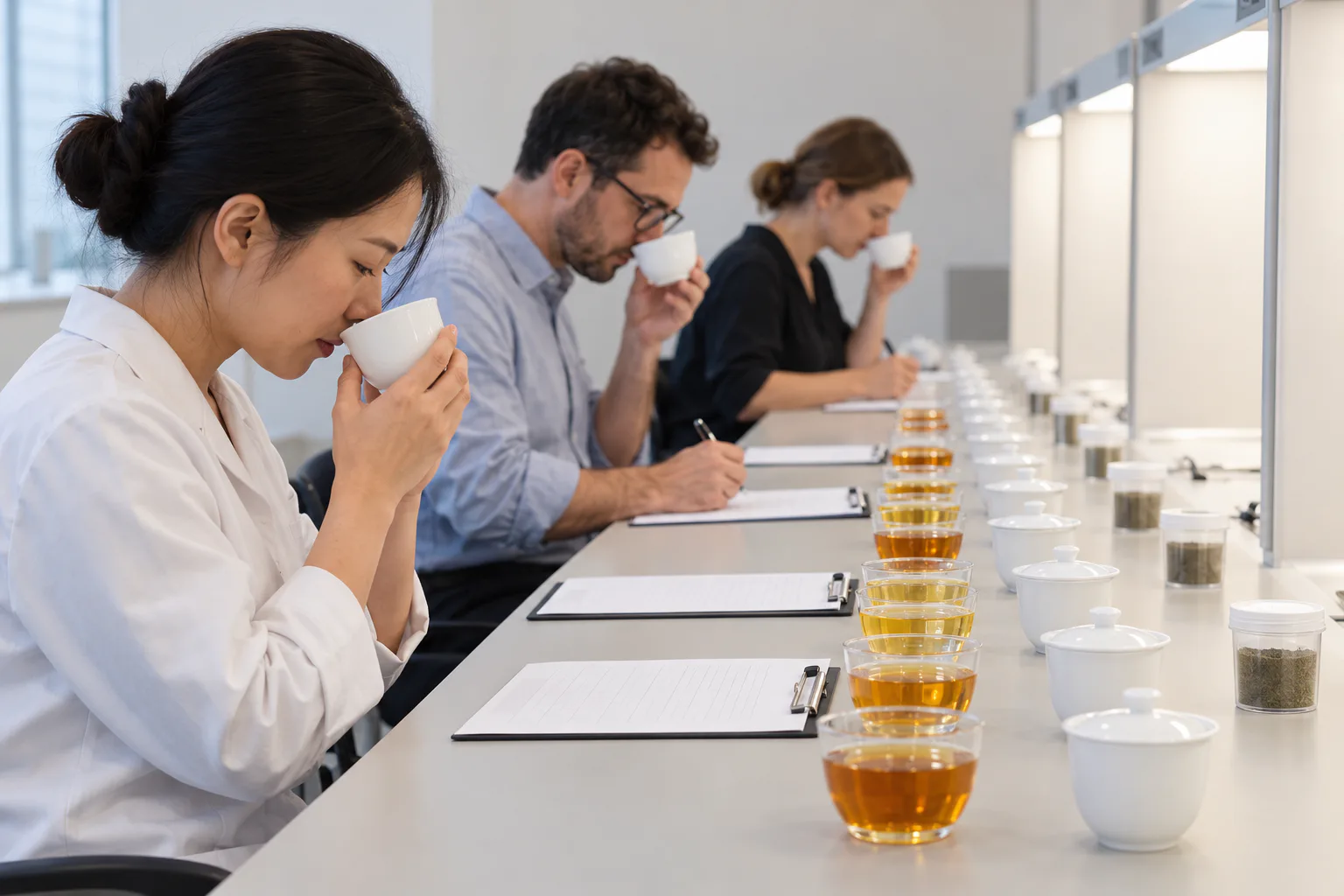
Step 4: Evaluate more than aroma
At a fixed serving temperature and time, record:
- tea aroma direction and intensity;
- brewed, leafy, floral, roasted, malty or other defined notes;
- bitterness, astringency, sweetness and aftertaste;
- color, haze, sediment and surface behavior;
- mouthfeel and body; and
- any change caused by the carrier or surrounding formula.
Use coded samples and separate descriptive assessment from preference.
Step 5: Apply the intended process
Compare samples before and after the qualified heat, cooling, filling or drying concept. Flavors may contain volatile components; tea extracts can also change with heat, oxygen and pH. Record the complete time–temperature path and tasting condition rather than describing the process only as “pasteurized.”
Step 6: Observe in the intended package
Follow a technically appropriate storage plan. A fresh sample can reveal category fit, but it cannot establish shelf life or flavor retention. Package, headspace, light and storage temperature belong to the finished-product study.
Common sourcing mistakes
Assuming every dry tea ingredient is instant tea
A dry format can be a soluble extract, milled leaf, filled preparation or dry flavor. Ask for exact identity and composition information. Physical form does not establish regulatory category.
Approving from dry aroma
A concentrated dry or liquid flavor may smell strong before dilution, while an instant tea powder may express more character after reconstitution. Judge both at their intended use condition.
Treating a flavor as a complete tea replacement
Replacing tea solids with flavor can change color, taste structure, haze and product identity. Revalidate the whole formula and label rather than comparing aroma only.

Treating “natural” as a global claim
The United States and European Union use specific but different frameworks, and other markets have their own rules. Obtain product-specific documentation and a current market review.
Using one specification for two categories
Moisture, solubility, carrier composition, sensory profile and microbiological criteria may be presented differently. Build an approval checklist appropriate to the named material instead of copying an instant-tea specification onto a flavor.
Questions to ask a supplier
- What is the exact commercial and regulatory description of the sample?
- Is it a soluble tea extract, milled tea, flavoring preparation or compound product?
- What ingredients or carriers are declared in the supplied composition information?
- Which product-specific specification applies?
- What preparation and application conditions were used for the sample guidance?
- Which lot documents can be supplied, and at what stage?
- What storage and handling instructions apply?
- How will an approved sample connect to later commercial material?
- What information is available to support the buyer's destination-market review?
These questions do not imply that every category or document is available from Healsun.
Frequently asked questions
Is tea flavor the same as instant tea powder?
No. Instant tea powder is a tea-extract ingredient within its product-specific definition, while tea flavor is intended primarily to impart or modify odor or taste. Exact composition and legal status must be confirmed for the named product and market.
Can tea flavor replace instant tea powder one to one?
Usually not. Their functions, use levels and physical effects differ. Replacement can change aroma, taste, color, solids and labeling, so the complete product needs redevelopment and review.
Does instant tea powder contain flavoring?
It depends on the product. ISO 6079 has explicit scope exclusions, and commercial products vary. Review the named product's composition and specification rather than assuming.
Can a beverage contain both instant tea and tea flavor?
Potentially, if the formulation, safety and market requirements permit it. The combination should have a clear sensory purpose and transparent product-specific documentation.
Which option is better for a clear beverage?
Neither category is automatically clearer. Test the exact ingredient at the intended dosage, pH, process and storage conditions. A flavor carrier can affect clarity, and a tea extract can differ by product.
Which is more heat stable?
There is no category-wide answer. Stability depends on composition, matrix, oxygen, process and package. Use controlled pre- and post-process comparisons.
How should the finished product be labeled?
That depends on the ingredient, product identity, claims and destination market. Obtain current advice from qualified regulatory professionals; this article is not a labeling determination.
Conclusion
Instant tea powder and tea flavor solve different formulation problems. Start with the function the finished product needs, verify the exact ingredient identity, then compare candidates in one controlled formula through the intended process and package. Keep sensory, physical and labeling decisions connected to product-specific documents. This prevents a strong aroma sample from being mistaken for the right tea ingredient category.