Introduction
Spray drying and freeze drying can both convert concentrated tea extract into a stable powder, but they do so through different physical processes. Buyers often assume that freeze-dried instant tea is always “premium” and spray-dried tea is always the economical option. That shorthand can be directionally useful, yet it is not enough for a commercial decision.
Tea type, extraction conditions, concentration, carrier use, drying parameters, final moisture, particle structure, packaging and storage all influence the finished powder. A well-matched spray-dried product may outperform an unsuitable freeze-dried sample in a specific beverage. Conversely, a project with a delicate aroma target may justify the additional cost and handling characteristics of a freeze-dried option.
Short answer: compare the finished products, not drying-method labels alone. Freeze drying uses frozen material and vacuum sublimation, which can reduce thermal exposure but often costs more and creates porous, brittle particles. Spray drying atomizes liquid into heated air, supporting efficient continuous production but exposing the product to thermal and airflow conditions. Test sensory quality, dissolution, powder handling, process fit, packaging, documents and total cost in the actual beverage.
This guide is for beverage brands, manufacturers, importers, procurement teams and product developers evaluating instant black, green, jasmine, oolong or related tea powders. It does not claim that one method is universally superior or that published laboratory results represent a specific Healsun product.
How spray drying and freeze drying differ
Spray drying
In spray drying, a liquid tea extract or formulated feed is atomized into small droplets in a stream of heated air. Moisture evaporates rapidly, and dried particles are separated and collected. The process can run continuously and is widely used for food ingredients.
Key process variables include feed solids, viscosity, inlet and outlet temperatures, atomizer design, droplet size, airflow and residence time. The actual thermal history of the product is more complex than the inlet-air temperature alone, so buyers should avoid judging a powder from one temperature number without product evidence.
Freeze drying
In freeze drying, the tea extract is frozen and water is removed mainly by sublimation under vacuum. The lower-temperature approach can reduce some heat-related changes, but the process requires freezing, vacuum equipment and longer cycle time. The resulting material is often porous and brittle and may be milled or broken into the desired powder form.
The method is only one part of product identity
Ask whether the product is pure instant tea or includes a carrier or other ingredient. Wall materials such as maltodextrin or gum Arabic may be used in some dried-extract systems to support processing, protection or powder properties. Their presence affects composition, labeling, sensory intensity, dosage and cost.
ISO 6079:2021 specifies requirements for instant tea in solid form but excludes, among other categories, instant tea containing non-tea carbohydrates as bulking or filling agents. This makes product identity and composition an early sourcing question, not a detail to resolve after approval.
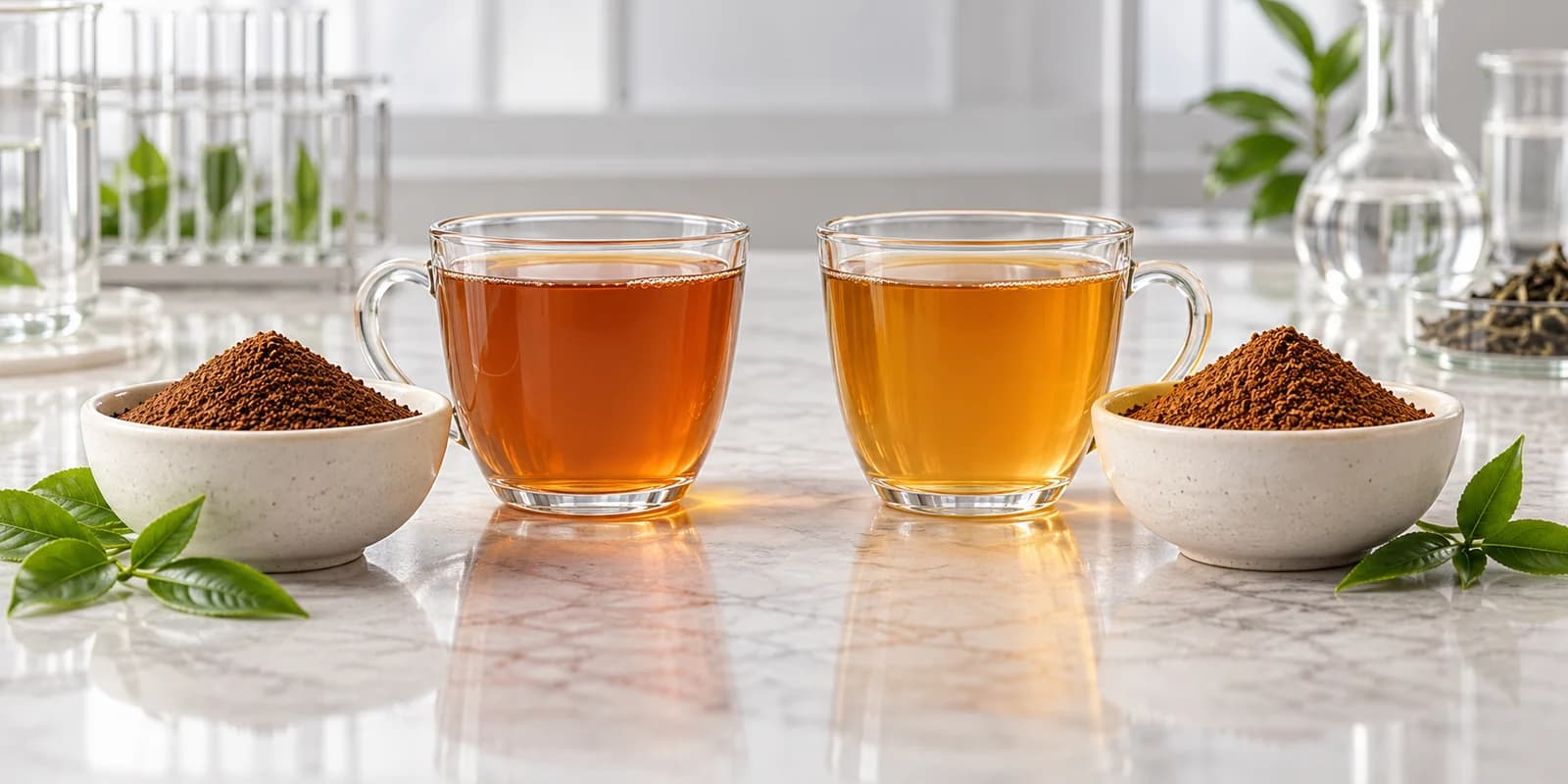
Spray-dried vs freeze-dried instant tea powder at a glance
| Decision factor | Spray-dried instant tea | Freeze-dried instant tea | Buyer action |
|---|---|---|---|
| Process concept | Atomized liquid dried in heated air | Frozen material dried by vacuum sublimation | Confirm the exact product and process description |
| Thermal exposure | Higher process-air temperatures, short residence | Lower-temperature drying after freezing | Compare actual sensory and analytical results |
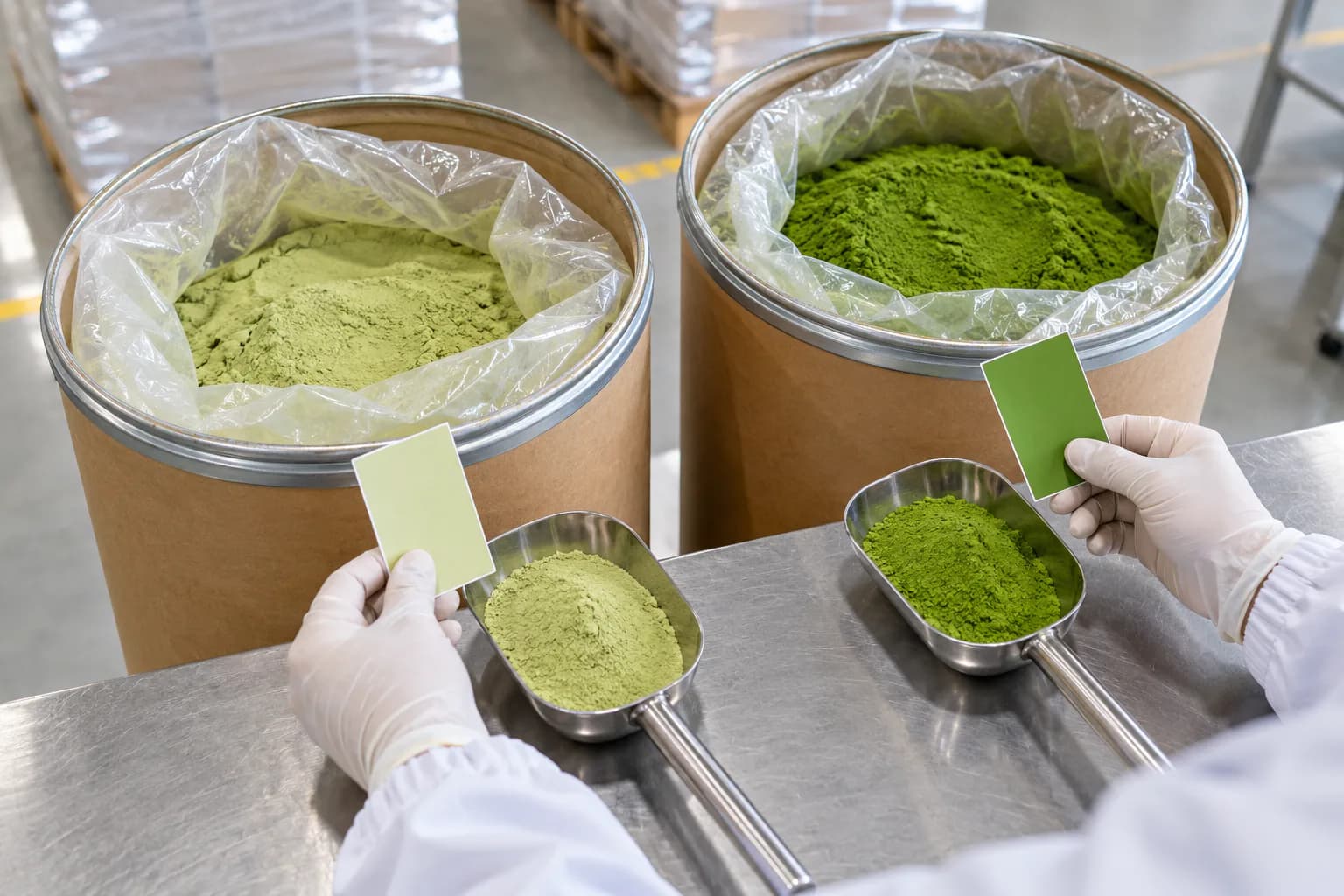
| Particle form | Often smaller, more spherical particles | Often porous, irregular, brittle structure | Test flow, dust, dosing and dissolution |
| Production economics | Commonly more scalable and cost-efficient | Commonly higher energy, time and equipment cost | Compare landed cost at effective dosage |
| Aroma and color | Product-specific; sensitive profiles may change | Can better retain some volatile or heat-sensitive attributes | Run coded sensory tests in the final beverage |
| Solubility | Can be high with suitable feed and process | Porous structure may support rapid reconstitution | Use one controlled test at real process conditions |
| Bulk density | Often higher, depending on process | Often lower because of porous structure | Check pack size, freight and warehouse implications |
| Moisture protection | Requires suitable barrier packaging | Also requires suitable barrier packaging | Follow product-specific storage instructions |
| Best fit | High-volume, cost-sensitive or robust sensory systems | Delicate sensory targets where benefits justify cost | Decide from the complete project requirement |
Bottom line: drying method is a useful screening variable, not a purchase specification by itself. The buyer should compare named samples and their complete technical and commercial packages.
What published research can and cannot tell buyers
Research helps explain likely trade-offs, but individual studies use specific teas, extraction conditions, dryers and analytical methods. Their numerical results should not be copied into a supplier specification without validation.
A comparative study of instant black, green and jasmine teas reported that freeze-dried samples better maintained sensory quality than spray-dried samples under the tested conditions. The magnitude of the difference depended on the raw tea: black tea was more stable across the methods, while jasmine aroma was more affected by spray drying in that experiment.
A 2025 review of instant tea and herbal powders described how drying method and wall material influence moisture, water activity, particle morphology, bulk density, solubility and protection of sensitive compounds. It emphasized that the optimal wall material and drying approach depend on intended use, core material, functional requirements, cost and regulatory acceptability.
Another 2025 study comparing conventional spray drying, freeze drying and electrostatic spray drying for instant green tea found significant differences in moisture, water activity, solubility and sensory results under its experimental conditions. These results show why buyers should ask for product-specific evidence rather than relying on a category stereotype.
The responsible conclusion is not “freeze drying always preserves quality” or “spray drying always dissolves better.” It is that drying method can materially influence a tea powder, and the finished product must be tested for the attributes that matter to the intended beverage.
Define the application before requesting samples
The same sample pair may produce different decisions for a jasmine RTD tea, a black milk tea and a powdered drink mix. Send the supplier a concise application brief containing:
- tea type and desired origin or sensory direction, where relevant;
- finished beverage and serving format;
- dosage range and target tea strength;
- water, sugar, acid, milk, juice, flavor and stabilizer system;
- required clarity or opacity;
- mixing, heat treatment, filtration and filling process;
- intended storage and shelf-life validation plan;
- destination market and required documents;
- target trial quantity, annual volume range and pack preference;
- cost objective expressed at finished-beverage use level where possible.
Ask for named samples that fit the brief. Do not request “one spray-dried and one freeze-dried” without also aligning tea type, sensory direction and composition; otherwise the comparison may confound multiple variables.
Build a fair sample comparison
Confirm product identity first
For each candidate, record:
- exact product name and code;
- tea type and ingredient statement;
- spray-dried or freeze-dried designation;
- carrier or processing-aid information where relevant and discloseable;
- lot or sample reference;
- current specification and representative COA;
- proposed commercial pack and storage instruction.
If the two samples differ in tea raw material, concentration or carrier content, record those differences. The trial can still be useful, but the result should not be attributed to drying method alone.
Use a controlled water screen
Prepare equal concentrations using the same water, temperature, addition method and mixing energy. Record dissolution time, visible particles, foam, color, aroma, taste, haze and sediment at defined intervals.
For a cold-process beverage, run the test at the actual cold temperature. For a hot premix, use the intended preparation condition. A single room-temperature screen cannot represent every manufacturing process.
Use coded sensory evaluation
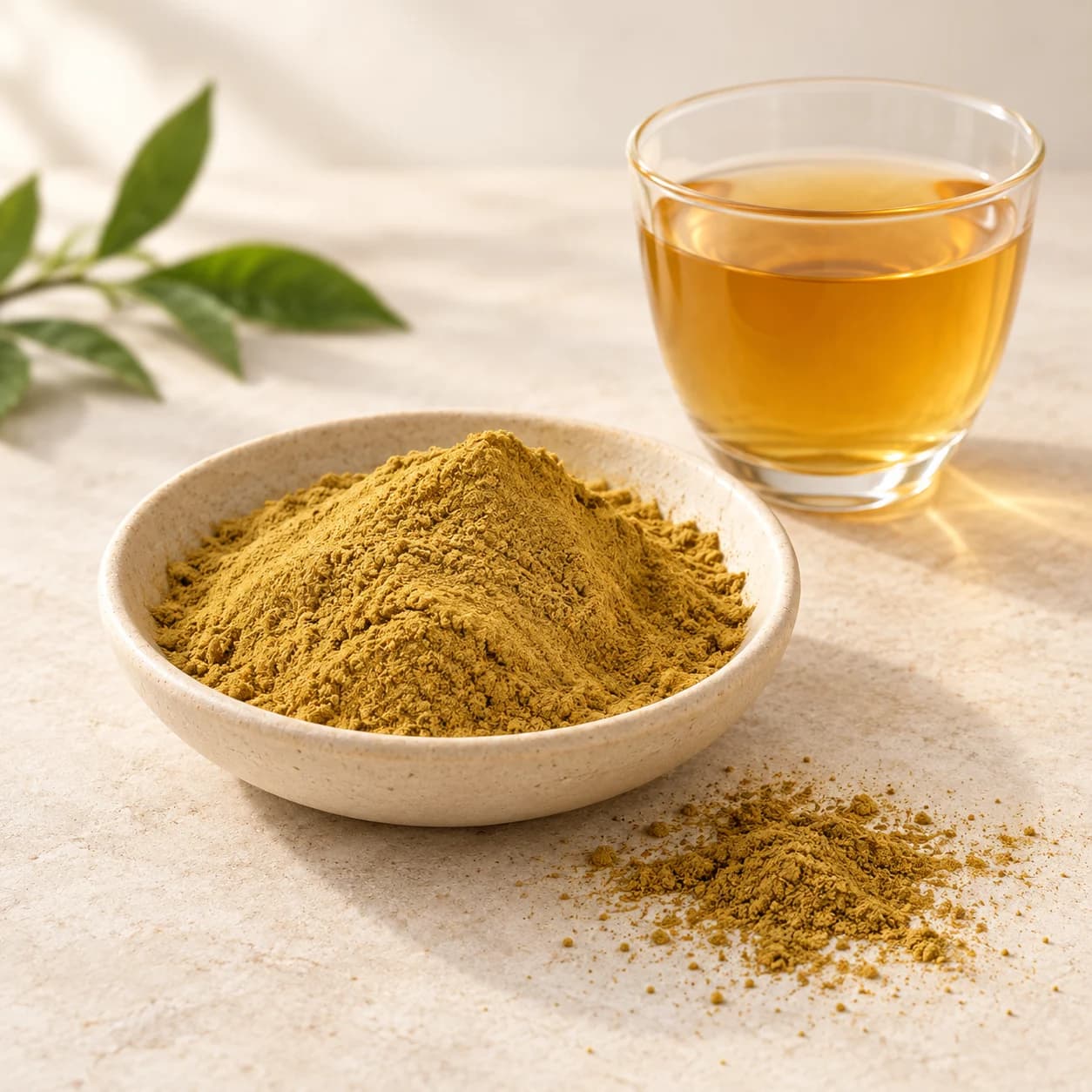
Serve coded samples in randomized order where practical. Evaluate tea identity, aroma intensity, cooked notes, bitterness, astringency, body, aftertaste and overall fit. Use the intended serving temperature.
When the test involves jasmine or another aroma-led profile, include aroma retention after the planned process and hold. When it involves milk tea, judge whether tea character remains recognizable after the dairy or plant base is added.
Repeat in the complete formula
Add each candidate to the complete beverage using the planned order of addition. Apply the intended heat, homogenization, filtration and filling conditions at a suitable scale. Observe immediate changes and include the product in the formal stability program.
Compare sensory quality without overgeneralizing
Aroma
Volatile aroma compounds can be sensitive to processing and storage. Freeze drying’s lower-temperature mechanism may support retention in some products, while spray-drying conditions, feed composition and encapsulation can also be optimized. The only commercially meaningful answer is the aroma delivered by the selected sample after the buyer’s process and storage.
Color
Tea color depends on raw material, extraction, concentration, drying, pH, oxygen, light and beverage ingredients. Compare color under controlled lighting after the complete manufacturing simulation. If color is a critical quality attribute, use an agreed instrumental or reference method.
Taste and aftertaste
Drying can influence the balance of tea compounds, but so can extraction and raw tea selection. Evaluate bitterness, astringency, sweetness perception, body and aftertaste at the effective dosage. A sample with a higher price per kilogram may use at a lower dosage—or may not. Measure rather than assume.
Shelf-life behavior
A fresh bench tasting does not predict commercial shelf life. Validate the formula in the intended package under an appropriate stability and food-safety plan. Monitor relevant sensory, physical, chemical and microbiological attributes based on the product risk assessment.
Compare powder handling and factory fit
Drying method can influence particle morphology, bulk density, flow and dust, but product-specific behavior varies. During a pilot trial, record:
- pack opening and powder flow;
- dust generation during dosing;
- tendency to clump after opening;
- wetting and vessel-wall adhesion;
- mixing time and foam;
- deposits in tanks, lines or filters;
- yield and cleaning effort;
- pack volume required for the same tea solids or beverage output.
Porous freeze-dried material may occupy more volume at a given mass. This can affect packaging, freight, warehouse space and dosing equipment. Spray-dried particles may have different flow and dust characteristics. Obtain actual bulk-density and pack information for the offered product rather than relying on generic assumptions.
Plan for moisture exposure
Both product types require protection from moisture, oxygen, light or heat according to the supplied storage instruction. Dried food powders can absorb moisture from humid air, affecting flow and stability.
Discuss:
- primary-pack barrier and closure;
- pack size relative to daily use;
- resealing after opening;
- warehouse temperature and humidity controls;
- maximum open-pack handling time, if specified;
- use of inner liners or secondary protection;
- sample storage during qualification.
The best laboratory sample can underperform if the commercial pack is left open beside a humid production line.
Compare total cost, not only price per kilogram
Freeze-dried products commonly carry higher processing costs, but the business decision should use the cost of the finished beverage. Build a total-cost comparison including:
- price per kilogram;
- effective dosage needed for the sensory target;
- freight and duty;
- packaging volume and warehouse space;
- powder loss and dust;
- mixing time and energy;
- yield and filtration loss;
- cleaning time;
- rejected or reworked batches;
- document and inspection requirements;
- minimum order and inventory exposure.
For example, a lower-priced powder that needs a substantially higher dosage may not be the lower-cost choice. A higher-priced product that preserves a critical jasmine aroma may create commercial value for a premium beverage. The answer depends on the product positioning and process.
Documents to request from the supplier
Request a product-specific package rather than a generic drying-method brochure:
- current product specification;
- ingredient or composition statement;
- representative and batch-specific COA expectations;
- product code and lot-coding explanation;
- drying-method description where commercially discloseable;
- moisture, water-activity or physical criteria relevant to release;
- solubility or reconstitution method where claimed;
- sensory criteria and preparation method;
- packaging, storage and shelf-life information;
- available allergen, microbiological, contaminant and residue information required by the buyer’s risk assessment;
- applicable food-safety certificates and site information;
- change-control and notification expectations.
Do not assume that freeze drying guarantees live microorganisms, higher antioxidant activity, a specific nutrient level or any consumer claim. Those claims require evidence for the exact product, process, storage and destination-market rules.
When spray-dried instant tea may be the better fit
Spray-dried instant tea may be a strong candidate when:
- the project requires scalable, cost-conscious supply;
- the tea profile is robust enough for the process;
- the selected sample meets aroma, color and taste targets;
- powder flow and dosing fit the factory;
- continuous production and commercial availability are priorities;
- the effective dosage delivers the required value.
This is a screening list, not a guarantee. Confirm every point for the named product.
When freeze-dried instant tea may be the better fit

Freeze-dried instant tea may deserve priority when:
- a delicate aroma or sensory profile is central to the product;
- the buyer accepts the cost after finished-beverage evaluation;
- the porous powder’s handling and packaging fit operations;
- lower thermal exposure is a relevant product-development objective;
- the named sample shows a measurable advantage after the intended process.
Again, drying method alone does not prove the benefit. The sample must earn the decision.
Common sourcing mistakes
Assuming freeze-dried means universally superior
Quality is application-specific. A spray-dried product may fit the sensory, process and cost target better.
Comparing different teas and blaming the dryer
Raw material, extraction and composition can dominate the result. Record every known difference.
Ignoring carriers or other ingredients
Composition affects label, dosage, sensory intensity and specification scope.
Testing only fresh water preparations
Repeat the comparison in the complete formula and process and include stability work.
Comparing price without dosage and logistics
Use cost per finished beverage and include pack volume, freight, yield and processing.
Approving a method instead of a product
Approve the exact code, sample, specification and lot-control plan.
FAQ
Is freeze-dried instant tea better than spray-dried instant tea?
Not in every application. Freeze drying can reduce thermal exposure and may better retain delicate sensory attributes in some products, while spray drying can offer efficient scale and cost. Compare named samples in the final beverage before deciding.
Does freeze-dried instant tea dissolve faster?
Porous freeze-dried structures can reconstitute readily, but dissolution depends on the complete product, particle structure, carrier, dosage, water temperature and mixing method. Use a controlled test under actual process conditions.
Is spray-dried tea powder lower quality?
No. Spray drying is a widely used food process, and product quality depends on raw tea, extraction, feed formulation, drying conditions, packaging and storage. A well-designed spray-dried tea can be the best commercial fit for a beverage.
Does freeze-dried tea contain more nutrients?
That cannot be assumed. Lower-temperature drying may protect some heat-sensitive compounds, but composition is product-specific. Request analytical evidence for the exact product and avoid nutrient or health claims without destination-market substantiation.
Why do some instant tea powders contain maltodextrin?
Maltodextrin or other wall materials may support drying, encapsulation, flow, stability or reconstitution. Ask for the ingredient statement and amount or specification information available, then evaluate label, dosage, sensory and regulatory implications.
Which method is better for jasmine tea?
Jasmine aroma can be process-sensitive, and one comparative study found stronger sensory retention with freeze drying under its test conditions. That evidence supports testing a freeze-dried option, but the buyer should still compare actual commercial samples after the intended beverage process.
Conclusion
Spray drying and freeze drying create meaningful differences, but neither method is a complete quality grade. The purchase decision should begin with a beverage brief and end with evidence from the exact sample, formula, process, specification and commercial supply plan.
Use drying method to ask better questions: What was protected? What changed? How does the powder handle? Which composition is being offered? What is the cost at effective dosage? Which batch controls connect future shipments to the approved result? Those answers are more valuable than a simple “spray-dried” or “freeze-dried” label.
Final CTA: compare samples for your real beverage
Considering spray-dried or freeze-dried instant tea? Send Your Requirements with the tea type, beverage, process, sensory target, destination market and expected volume. Healsun can discuss relevant sample options and the product-specific information to confirm before an order.
References
- ISO 6079:2021 — Instant tea in solid form — Specification
- Widely targeted metabolomics reveals the effect of raw materials and drying methods on instant tea quality
- Advances in spray-drying and freeze-drying technologies for instant tea and herbal powders
- Effect of different drying processes on the chemical, sensory and volatile characteristics of instant green tea
- FAO guidance on packaging dried foods and moisture uptake