Introduction
Tea aroma is not one compound and does not remain fixed after a powder is added to water. A tea's sensory character arises from a complex volatile profile, while the finished ready-to-drink beverage may be mixed, acidified, heated, cooled, transferred, filled and stored. Each step can change what reaches the consumer's nose.
Short answer: To evaluate tea aroma stability in an RTD beverage, compare the same coded formulation before and after each major process step, control oxygen exposure and serving conditions, and store samples in the intended package under a qualified protocol. Use descriptive sensory assessment as the primary practical tool, supported by appropriate analytical work when the decision warrants it. A strong dry-powder aroma does not guarantee aroma retention after processing.
This article explains a development framework, not a universal shelf-life method or a claim about any Healsun product or facility.
Why tea aroma changes
Tea volatile compounds can arise from several biochemical pathways and processing reactions. Reviews describe contributions from lipid-, carotenoid-, glycoside- and amino-acid-related pathways, among others. The perceived result depends not only on concentration but also on odor thresholds and interactions among compounds.
In a beverage, four practical forces deserve attention:
- Heat may drive evaporation, release compounds from precursors or promote chemical change.
- Oxygen can support oxidation reactions and can enter through mixing, transfer, headspace or package permeability.
- Light can initiate or accelerate reactions in susceptible ingredients and packages.
- Time and temperature allow reactions and migration to continue during distribution and storage.
The formula also matters. Acids, sweeteners, flavors, juice, proteins and other components may change volatility or sensory perception. Therefore, an ingredient-only aroma test and a finished-beverage stability test answer different questions.
Define “stable aroma” before testing
“Good retention” is too broad for a decision. Create a short sensory target using terms meaningful to the product, such as fresh leaf, floral, roasted, malty or citrus-like. Also list unacceptable directions, but describe them neutrally rather than implying contamination or failure.
Define:
- reference sample and preparation;
- target serving temperature;
- package and pour method;
- attributes and rating scale;
- acceptable change for the development stage;
- panel or reviewer qualifications; and
- decision date and responsible team.
Stability does not have to mean zero change. The commercial question is whether the beverage remains within its validated identity and acceptance criteria over the claimed period.
Separate ingredient selection from process diagnosis
An instant tea powder, a milled leaf powder and an in-house infusion bring different material into the drink. Confirm identity first. ISO 6079 specifies requirements for instant tea in solid form within its stated scope; it does not establish a finished RTD aroma-retention claim.
For candidate selection, compare named samples in one fixed formula and process. For process diagnosis, use one tea sample while changing a single controlled step. Mixing both questions in one experiment makes it difficult to know whether a difference came from the ingredient or the process.
Build an aroma process map
Map the route from ingredient to tasting cup:
- dry ingredient or liquid extract receipt;
- opening and weighing;
- dissolution or extraction;
- blending and acidification;
- holding before heat;
- thermal process;
- cooling and transfer;
- filling and closure;
- storage and distribution; and
- opening, pouring and consumption.
At each stage, identify temperature, time, agitation, open surface, headspace and exposure to light. This map does not prove the source of aroma change. It identifies useful sampling points.
A staged testing framework
Stage 1: Establish a fresh reference
Prepare the tea candidate by a documented method using approved water. Evaluate it promptly at the target serving temperature. Record aroma terms and intensity, plus bitterness, astringency and color because they influence overall perception. Retain sample identity and preparation records.
Dry-powder smelling can support incoming description but should not determine RTD suitability. Volatiles released from dry powder may not be the same as those perceived after dilution and processing.
Stage 2: Compare complete-formula samples
Add the tea to the full base. Include a no-tea control when it helps separate background flavors. Use coded sensory evaluation and fixed timing. If a flavor system is present, compare tea before and after flavor addition to understand masking or enhancement without making unsupported chemical claims.
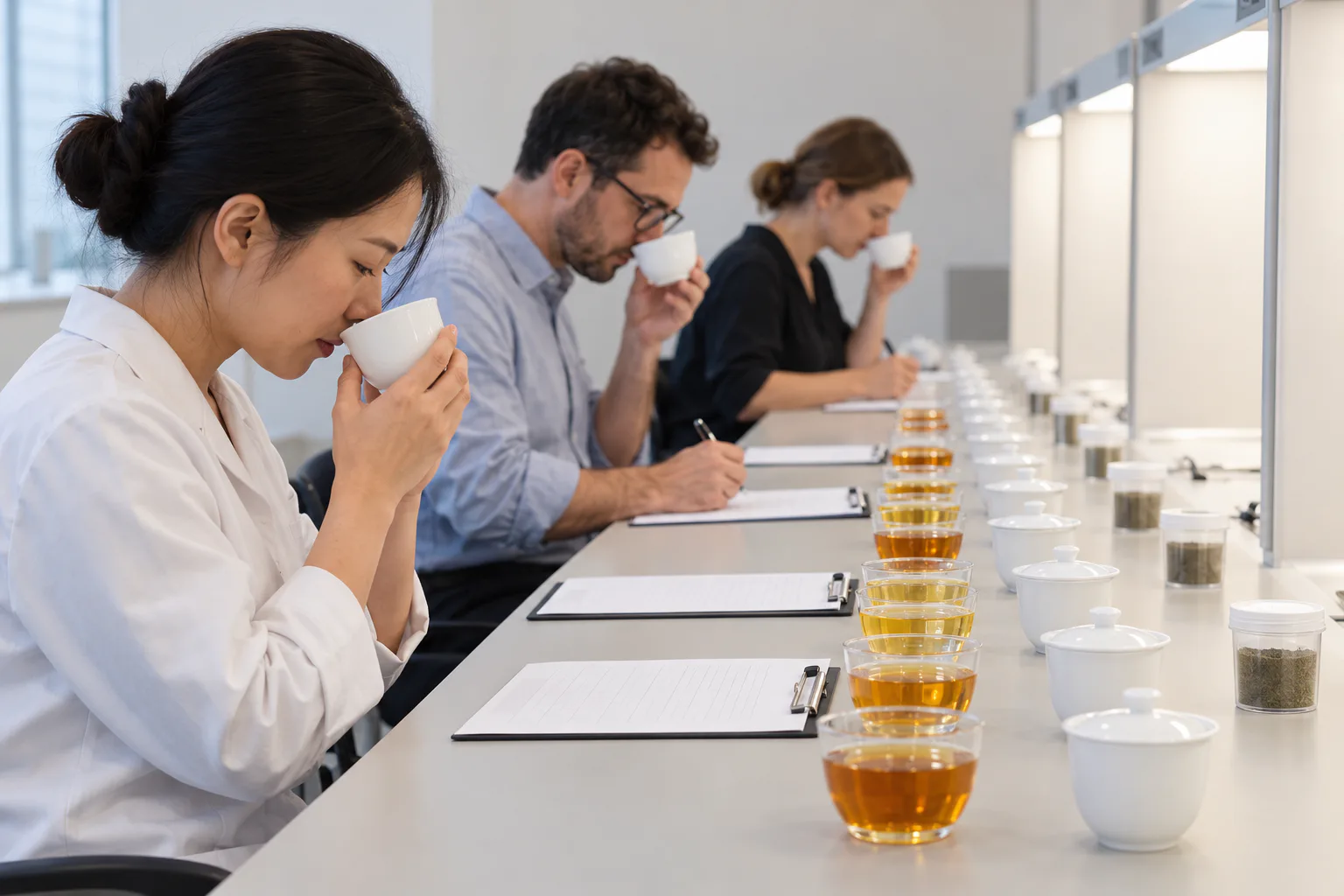
Stage 3: Sample before and after heat
Apply only the project's qualified process concept. Record the actual time-temperature history available to the team, not just the equipment set point. Cool samples consistently and evaluate at the same temperature. A hot sample releases aroma differently from a chilled one.
Heat can reduce some fresh notes while generating or revealing others. Record the direction and magnitude of sensory change rather than using a simple pass/fail label too early.
Stage 4: Examine oxygen exposure
Compare the plant's normal controlled process with a technically justified oxygen-control variant designed by qualified staff. Relevant records may include dissolved oxygen at selected points, headspace management, mixing aeration and transfer conditions. Do not infer oxygen exposure from foam alone.
If analytical instruments are unavailable, use process observations carefully and avoid claiming a mechanism. A sensory difference can establish that two processes differ; it does not identify the exact reaction.
Stage 5: Compare package and light conditions
Package material, closure, headspace and light barrier may influence aroma over time. Store samples in the intended package and, if needed, a protected control. Light-exposure studies should use defined conditions set by technical specialists; a bottle left on a windowsill is not a reliable commercial simulation.
Evaluate package interaction as part of the beverage system. Avoid declaring one material universally superior without product-specific evidence and broader packaging validation.
Stage 6: Run a qualified storage study
Select time points, temperatures and handling conditions that match the decision. Real-time storage is the foundation for a shelf-life claim. Accelerated conditions can help compare patterns, but results should not be converted mechanically into a commercial shelf life unless a validated model supports that use.
At each point, inspect package integrity, appearance and aroma under the approved safety program. Sensory assessment must not be performed on samples that have not been cleared for tasting.
Sensory methods that improve decision quality
Use coded, randomized samples
Brand, supplier and treatment knowledge can bias perception. Use neutral codes and vary serving order. Keep cup, volume, temperature and time after opening constant.
Separate description from preference
A sample can be less floral yet more appropriate for a roasted-tea concept. Ask panelists first what changed, then whether the result fits the brief. This produces more useful development evidence than a single “like” score.
Train on a limited vocabulary
Long aroma wheels can overwhelm a small project. Select a few relevant attributes and anchors. Define “roasted,” “fresh,” “floral” or “malty” for the team. Record uncertainty rather than forcing a false distinction.
Use difference testing when appropriate
Triangle or paired-comparison designs can help determine whether panelists detect a difference, while descriptive scoring estimates direction and size. Statistical design and panel size should match the decision and be reviewed by a qualified sensory specialist.
When analytical testing adds value
Gas chromatography–mass spectrometry and related headspace techniques can profile volatile compounds. Odor activity analysis considers concentration relative to odor threshold. These tools can help investigate mechanisms or track markers, but they do not replace sensory assessment: a chemical difference may not be perceivable, while a sensory change may reflect multiple compounds and matrix effects.
Use analytical work when it will change a decision—for example, comparing two process variants, explaining a recurring sensory shift or validating a research hypothesis. Select methods and target compounds with a competent laboratory. Do not publish a generic volatile panel as proof of commercial shelf life.
Troubleshooting patterns without overclaiming
Fresh aroma drops immediately after heat
Verify equal tasting temperature and dilution first. Review heating, holding, cooling and open transfer. Compare a post-mix/pre-heat sample with a post-heat sample produced in the same run. If the change repeats, test technically justified process or ingredient alternatives rather than simply increasing dosage.

Aroma is acceptable at filling but changes during storage
Review package, headspace, oxygen, light, storage temperature and the complete formulation. Research on tea beverages and stored tea demonstrates that volatile profiles can evolve with time and temperature, but a published compound trend does not diagnose a specific product. Use the actual package study.
One package retains aroma better in a short test
Confirm fill, closure, headspace, storage and sample identity. Repeat the comparison. A short sensory difference may justify further work, but packaging selection also requires safety, compatibility, mechanical, sustainability, regulatory and commercial review.
The aroma is strong but the beverage tastes unbalanced
Aroma intensity is only one goal. Evaluate bitterness, astringency, sweetness, acidity and aftertaste. The best candidate is the one that fits the complete brief, not necessarily the powder with the strongest headspace note.
Results vary between panel sessions
Check serving temperature, opening time, sample order, room odor, panel availability and reference freshness. Volatile perception is sensitive to method. Improve control before concluding that the ingredient varies.
Procurement questions after technical screening
- What is the exact product name, tea format and sample identifier?
- Which product-specific specification applies?
- Are added aromatic materials present, and how is identity described?
- Which packing and storage guidance applies to the named product?
- What lot-related documents are available at the appropriate stage?
- How will the approved sample connect to a later commercial lot?
- What change-notification expectations should be agreed?
- Which claims or label statements require buyer validation in the destination market?
Do not convert a successful bench aroma test into an unsupported claim about composition, shelf life or regulatory status.
Frequently asked questions
Why does tea aroma weaken after pasteurization?
Heat and open handling can affect volatile compounds, but the outcome depends on the tea, formula, time-temperature history, cooling and sensory method. Compare controlled pre- and post-process samples before assigning a cause.
Does more tea powder improve aroma stability?
Not necessarily. A higher dosage may raise aroma initially but can also change bitterness, astringency, color, cost and physical behavior. Stability must be evaluated over the process and storage period.
Can nitrogen flushing preserve tea aroma?
Headspace and oxygen management may be useful in some systems, but suitability depends on the package, process and product. It must be designed and validated by qualified technical personnel; it is not a universal solution.
Does an opaque bottle always protect tea better?
Light protection can be relevant, but package performance includes more than opacity. Barrier properties, closure, headspace, compatibility and storage all matter. Test the actual package.
Can accelerated storage predict RTD tea shelf life?
It can support comparative learning when the relationship to real-time behavior is understood. It should not be converted automatically into a shelf-life claim without a validated model and appropriate safety program.
Should aroma be tested cold or at room temperature?
Test at the intended serving temperature, and keep it consistent. If the product may be consumed under multiple conditions, design separate comparisons rather than mixing temperatures in one panel.
Conclusion
Tea aroma stability is a whole-system question. Define the intended sensory identity, map the process, take controlled samples around heat and filling, examine oxygen and package conditions, and follow the beverage through a qualified storage study. Combine disciplined sensory work with targeted analytics when the decision warrants it. This approach is more reliable than selecting tea from dry aroma or making a shelf-life prediction from one fresh sample.
References
- ISO 6079:2021 — Instant tea in solid form — Specification
- Volatile Organic Compounds in Teas: Identification, Extraction, Analysis, and Application of Tea Aroma
- Recent Advances in Volatiles of Teas
- Physical and Chemical Property Changes, Cooked-Off Flavor Formation, and Its Alleviation During Storage of Green Tea Beverages