Introduction
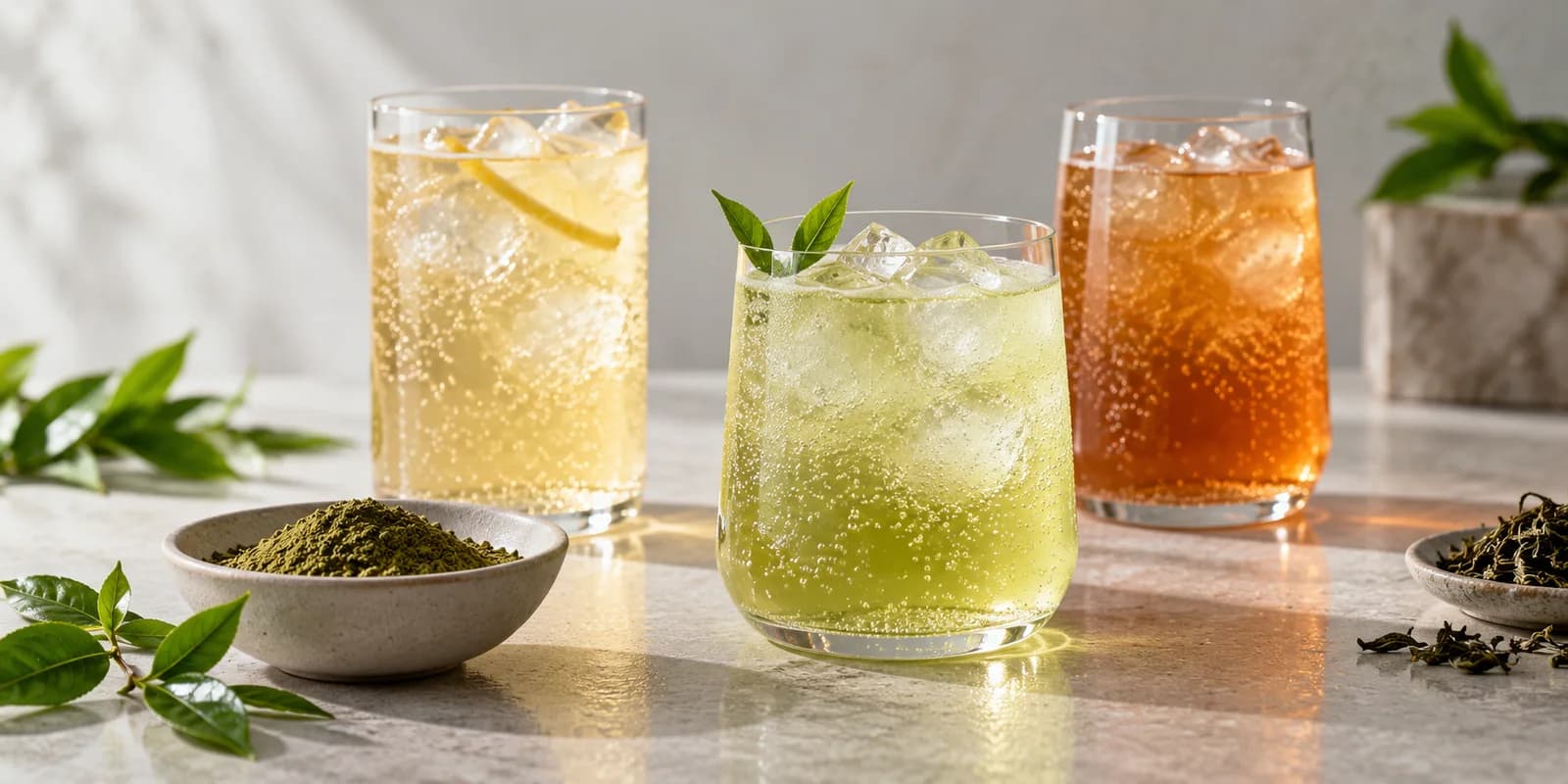
Carbonation can make a tea beverage feel brighter and more aromatic, but it also changes the development problem. Carbon dioxide lowers the beverage's measured pH after dissolution, contributes carbonic bite, increases aroma release during opening and pouring, and can magnify foam created by proteins, suspended particles or surface-active ingredients. A tea system that looks balanced as a still bench sample may taste sharper, foam more strongly or lose its intended aroma once carbonated.
Short answer: Tea powder can be used in carbonated beverages, but it should be selected and tested inside the complete acid, sweetener and flavor system. Developers should dissolve or disperse the tea reproducibly, chill before carbonation, compare controlled carbon dioxide levels, record foam and package behavior, and evaluate aroma and taste at the intended serving temperature. A still sample alone cannot predict the finished sparkling drink.
This article offers a general trial framework. It is not a commercial formula, a processing instruction for unqualified equipment, or a guarantee of shelf life, safety or regulatory suitability.
Start by defining what “tea powder” means
The ingredient name can refer to different formats. ISO 6079 covers instant tea in solid form within a defined scope. Matcha and other milled whole-leaf powders are particulate suspensions rather than fully soluble extracts. A flavored preparation may also contain components beyond tea. Buyers should therefore confirm the exact product identity and supplied information for every candidate.
| Format | Behavior in a sparkling drink | Main questions |
|---|---|---|
| Instant tea powder | Primarily soluble tea extract solids | Dissolution, clarity or haze, flavor balance and process response |
| Milled leaf powder | Suspended fine leaf material | Wetting, sediment, nucleation, mouthfeel and visual style |
| In-house brewed extract | Liquid infusion filtered by the manufacturer | Extraction repeatability, filtration, holding and water demand |
The desired visual concept matters. A clear sparkling tea and an intentionally cloudy matcha soda require different ingredients, process controls and consumer expectations. “Good solubility” is not a useful specification until the team defines the temperature, water, mixing method, concentration and acceptable appearance.
Why carbonation changes tea perception
Carbon dioxide affects acidity and sensory balance
Dissolved carbon dioxide forms carbonic acid in water. The final pH and titratable acidity also depend on the rest of the formulation and its buffering capacity. For development, measure the completed carbonated beverage under a consistent method rather than transferring a pH result from the still base.
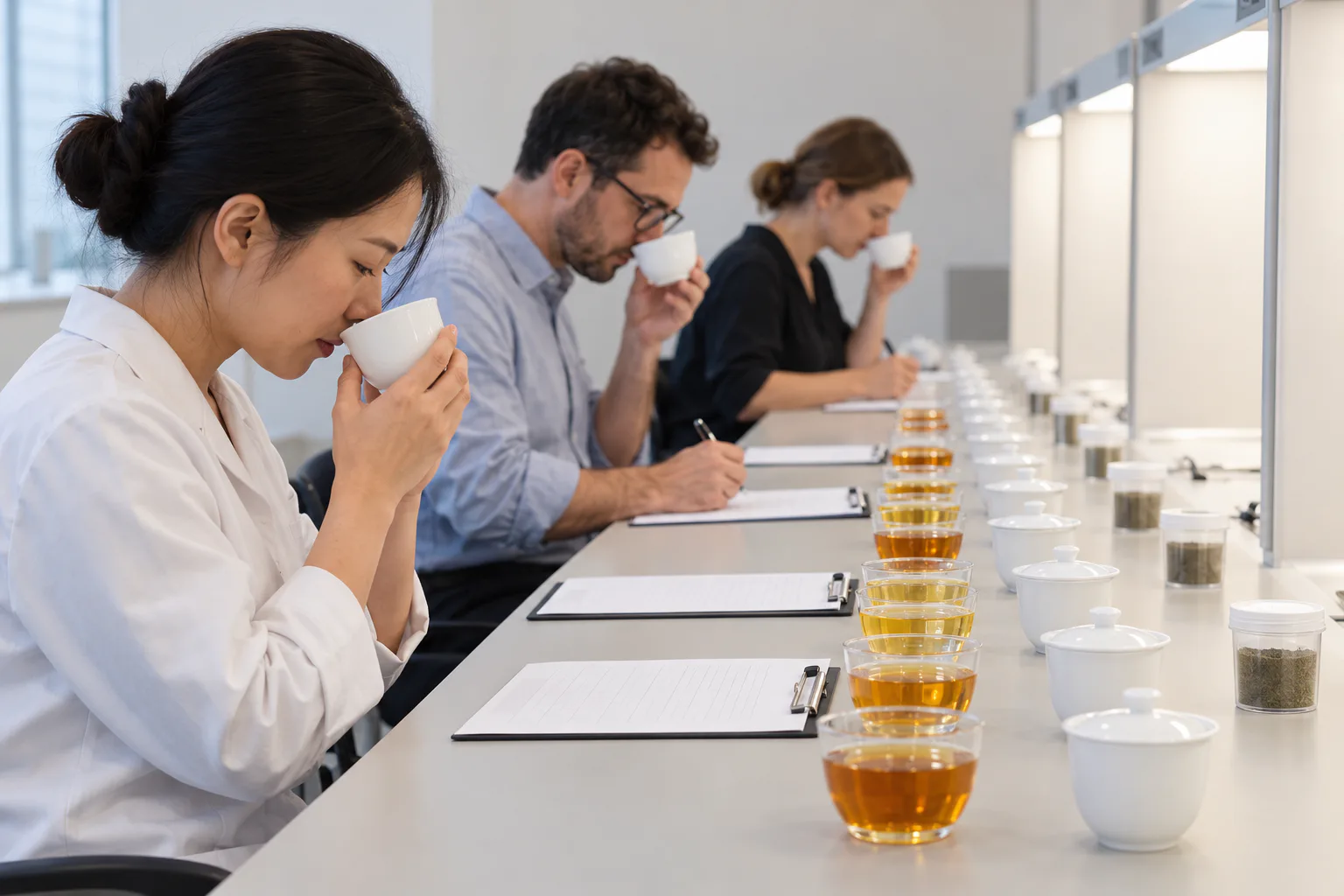
Carbonation adds trigeminal bite. This can make sweetness seem different and can shift the perceived balance of bitterness and astringency. It is safer to select dosage through coded tasting of the sparkling product than to approve a tea level in still water and assume the same balance will remain.
Bubbles influence aroma delivery
Opening and pouring release gas and volatile compounds. The first aroma impression may therefore be stronger but shorter-lived than in a still drink. Evaluate a fixed pour size, glass, temperature and time after opening. Otherwise, panelists may compare one freshly opened sample with another that has already lost much of its carbonation.
Particles and surfaces can promote bubble formation
Suspended leaf particles, undissolved agglomerates, vessel scratches and other surfaces can provide nucleation sites. This does not automatically make a material unsuitable, but it makes controlled preparation important. A whole-leaf sparkling beverage may naturally behave differently from a clarified drink.
Foam is a system result
Persistent foam may reflect the interaction of tea, juice, flavor carriers, proteins, stabilizers and the filling method. Do not attribute it to tea from a single observation. Run a no-tea control and change one variable at a time. Define a test such as maximum foam height and time to collapse under a standard pour instead of using “too foamy” as the only record.
Build an application brief before requesting samples
Provide enough context for a relevant ingredient discussion:
- tea type and intended sensory direction;
- clear, translucent, naturally cloudy or suspended appearance;
- instant extract, whole-leaf suspension or open-format request;
- still-base pH and acid system, if disclosure is permitted;
- sweetener and flavor architecture;
- target serving temperature and package type;
- carbonation and filling concept handled by the developer;
- heat treatment or other preservation concept;
- destination-market and documentation questions; and
- the observation that will determine whether a sample advances.
Avoid asking for a universally “best” powder. The better question is which named sample is worth testing for the stated matrix and process.
A controlled bench-to-pilot evaluation
1. Code candidates and preserve identity
Record the supplier reference, sample or lot identifier, receipt date and associated product information. Use neutral codes during sensory work. Keep sample records connected to the correct container; appearance alone is not reliable identification.
2. Standardize the process water
Water chemistry can influence tea color, taste and aroma. Peer-reviewed research on tea infusions has shown effects from mineral content and pH, although results for brewed leaves should not be treated as a direct specification for every instant powder. Use one documented water source for candidate comparison. If production water varies, run a separate water challenge rather than allowing uncontrolled variation inside the tea screen.
3. Prepare a fixed still base
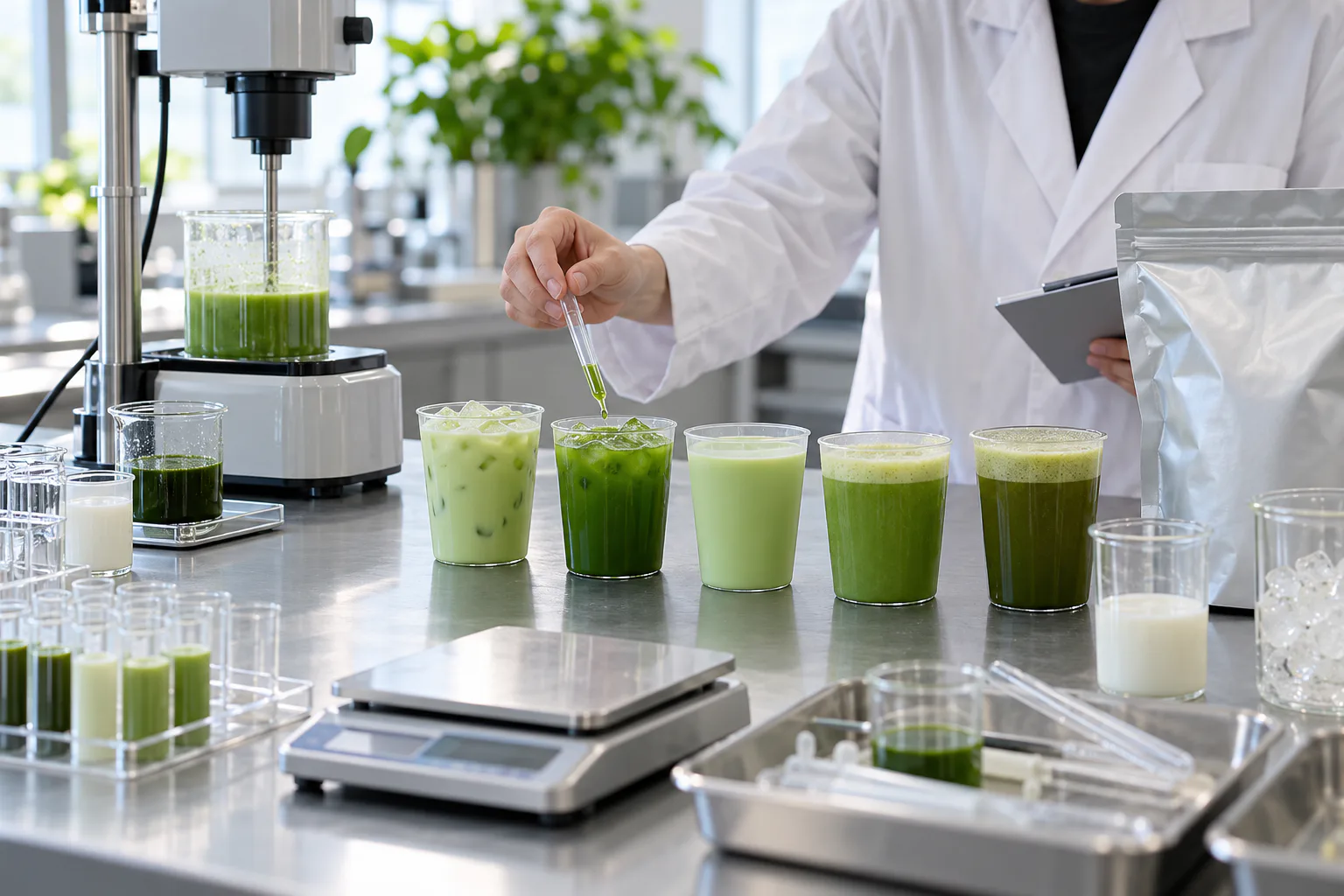
Make one control without tea and one sample for each candidate. Record actual weights, liquid temperature, mixer type, speed and time. Dissolve ingredients under a sequence that can plausibly scale. If a powder is pre-dispersed, document the carrier and ratio rather than treating the step as an informal workaround.
Inspect for wall deposits, dry islands and fine sediment. Uniform color is not proof of complete dissolution. Where appropriate, a standardized screen or filtration observation can help compare visible residue, but it should not be represented as a product-compliance test.
4. Check the still base before carbonation
Record color, clarity or haze, aroma, taste, pH and visible particles. This baseline separates problems introduced during preparation from changes observed after carbonation. If heat processing is planned, compare pre- and post-process samples before adding carbon dioxide.
5. Chill and carbonate consistently
Carbon dioxide solubility is temperature-dependent, so bring comparison samples to the same defined temperature. Use qualified equipment and facility procedures. Record the operational setting or measured result available to the development team. Do not improvise with pressure equipment or treat a bench appliance result as proof of commercial filling performance.
6. Use a standardized pour test
Open, pour and observe samples under repeatable conditions. Record:
- time and temperature at opening;
- package and fill level;
- glass geometry and pour method;
- initial foam height and collapse time;
- bubble persistence and visual uniformity;
- aroma immediately and after a fixed interval;
- sweetness, acidity, bitterness and astringency; and
- sediment or ringing after standing.
Video can support internal comparison when company policy permits, but the written method remains essential.
7. Move the preferred system to a representative package trial
Container surface, closure, headspace, filling temperature and agitation can change the consumer experience. A successful open-cup test is therefore only a screen. Package trials should use the actual or representative container and qualified process controls. Leakage, pressure safety, microbiological safety and shelf life require specialist validation.
How to interpret common observations
The drink foams excessively during filling or pouring
Compare against the no-tea control, then inspect undissolved solids, flavor carriers, proteins, mixing aeration, temperature and carbonation conditions. Repeat the test before changing the formula. If the issue appears only with a particulate tea format, decide whether suspension is essential to the concept or whether a soluble format better fits the desired behavior.
Aroma is strong on opening but fades quickly
This may reflect rapid volatile release rather than insufficient tea dosage. Evaluate the beverage over the normal consumption window. Increasing tea can also increase bitterness or astringency, so a complete sensory rebalance is more informative than changing one ingredient automatically.
The beverage becomes cloudy after acidification
Cloudiness can arise from tea components, suspended leaf, minerals, other flavor ingredients or their interactions. Record when the change occurs and compare each process stage. If clarity is a product requirement, define it instrumentally where possible and test the complete formula after processing and storage.
Sediment appears after carbonation
First determine whether sediment existed in the still base. Carbonation and handling may make existing particles more visible or redistribute them. Whole-leaf formats inherently contain particles; suitability depends on the intended style, resuspension behavior, mouthfeel and package instructions, not on an assumption that all tea powders must dissolve completely.
The pilot result differs from the bench sample
Compare addition point, tank geometry, mixing energy, residence time, heat history, cooling, carbonation temperature and filling. Scale-up is a process translation exercise. Do not label the ingredient inconsistent until preparation and sample identity have been checked.
A purchasing and documentation checklist
Once a candidate advances, connect application performance to a named product:
- What is the exact product name and tea format?
- Which sample identifier and product-specific specification apply?
- Are added components present, and what information is supplied for them?
- What packing and storage guidance applies to the named product?
- Which lot documents can be provided, and when?
- How will a later commercial lot be linked to the approved sample?
- What change-notification expectations should be agreed?
- Which destination-market questions require the buyer's independent review?
These questions are a discussion framework, not a claim that every document or feature is available.
Frequently asked questions
Can instant tea powder be carbonated?
Yes, it can be evaluated in a carbonated drink. Suitability depends on the exact powder, formula, dissolution method, acidity, carbonation, process and sensory target. Test the complete beverage rather than carbonating tea powder in plain water only.
Is matcha suitable for sparkling beverages?
It can suit an intentionally suspended, cloudy concept. Developers should assess wetting, nucleation, foam, mouthfeel, settling and package behavior. Matcha should not be judged by the expectations used for a soluble extract.
Should tea be added before or after carbonation?
Commercially, the ingredient is normally incorporated through a controlled beverage process rather than casually added to an already carbonated package. The safe, scalable sequence depends on equipment and formulation and must be designed and validated by the manufacturer.
Does carbonation reduce tea bitterness?
Not reliably. Carbonation changes acidity, aroma release and oral sensation, which can change perceived balance. Use coded sensory comparison at the intended serving condition.
How can foam be compared objectively?
Define the container, temperature, pour method, starting carbonation, maximum foam height and time to collapse. Include a no-tea control and repeat the test. This gives a comparative development record, not a universal quality limit.
Is a stable one-day sample enough for launch?
No. A short observation can screen candidates, but commercial decisions require appropriate process, package, microbiological and shelf-life validation.
Conclusion
A successful sparkling tea starts with a clear ingredient identity and a controlled complete-formula trial. Standardize water and mixing, establish a still baseline, carbonate at a controlled temperature, and evaluate foam, aroma, taste, appearance and package behavior under a repeatable pour method. Then connect the chosen sample to product-specific records before commercial approval.
References
- ISO 6079:2021 — Instant tea in solid form — Specification
- The types of brewing water affect tea infusion flavor by changing the tea mineral dissolution
- Effect of Water Hardness on Catechin and Caffeine Content in Green Tea Infusions
- Volatile Organic Compounds in Teas: Identification, Extraction, Analysis, and Application of Tea Aroma