
Introduction
Tea powder that looks fine and uniform in a dry package can behave very differently when it meets water, milk, sugar, acid or factory shear. Some powders float before wetting, some form dry-centered clumps, some feel gritty, and some settle after the drink appears uniform. These observations are often compressed into one vague question: “Is the powder soluble?”
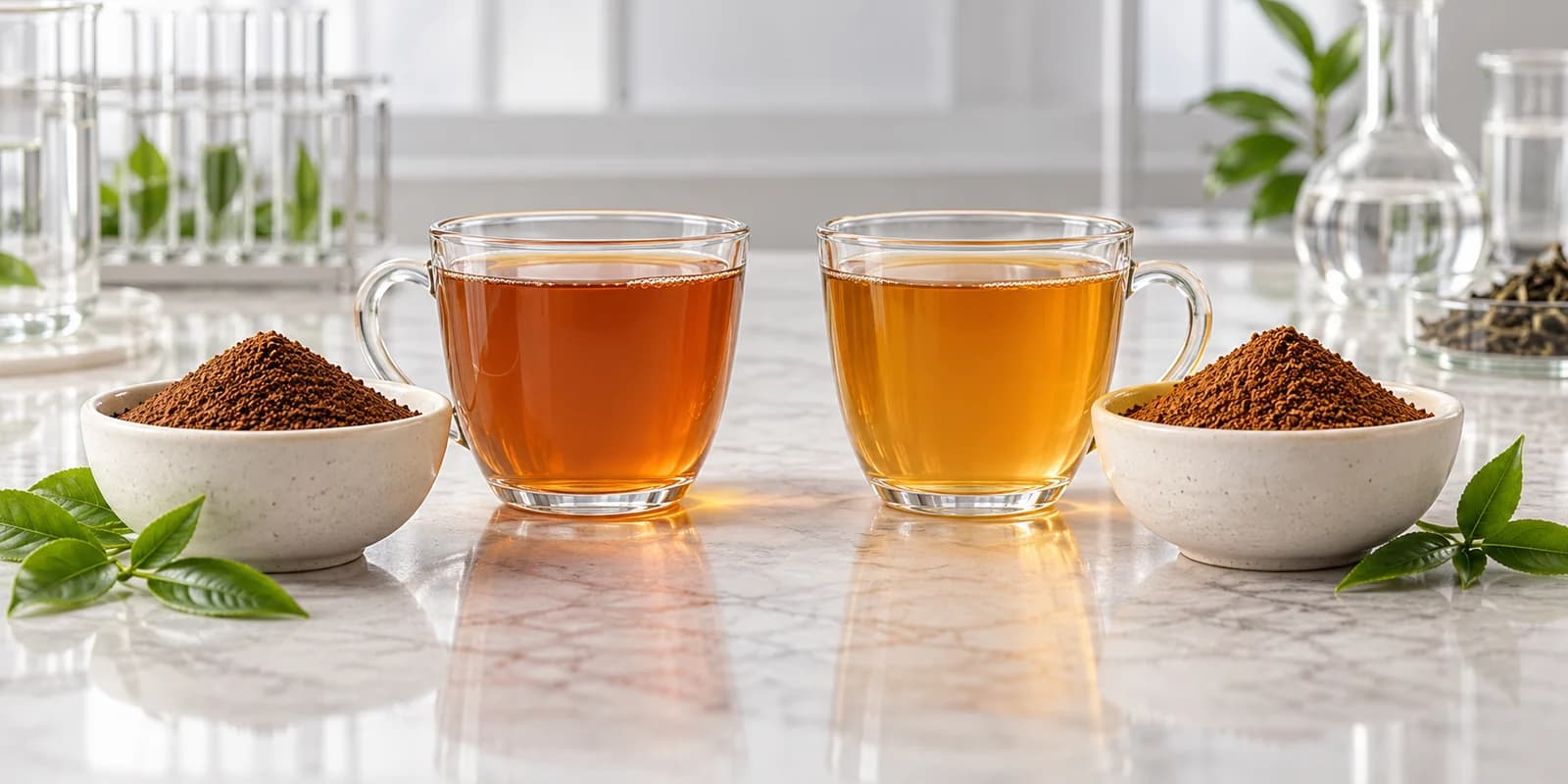
That question can hide an important category difference. Instant tea powder is typically a dried soluble extract. Matcha and other ultrafine whole-leaf tea powders contain plant particles that are dispersed or suspended rather than molecularly dissolved. A meaningful test must begin by identifying which material is being evaluated and what the finished beverage is expected to look and feel like.
Short answer: test wetting, deagglomeration, dispersion, sedimentation and mouthfeel as separate attributes. Keep dosage, liquid, temperature, addition method, mixing energy and observation intervals constant. Screen in a simple liquid, then repeat in the complete formula and planned process. Do not approve a powder from particle size or mesh alone.
This guide helps R&D, quality, procurement and production teams create a shared evaluation method. It does not prescribe universal particle-size or sediment limits. Those limits should reflect the ingredient category, beverage matrix, equipment, serving format and shelf-life objective.
First identify the tea ingredient category
Before testing, confirm whether the material is:
- an instant tea extract intended to dissolve;
- a finely ground whole-leaf powder intended to disperse;
- a formulated tea preparation containing a carrier or other ingredients;
- a blend of extract and leaf material;
- another powdered botanical product.
Two powders can share a similar color and particle appearance while requiring different acceptance criteria. For a pure instant tea, visible insoluble material may signal a problem. For matcha, suspended leaf particles are intrinsic to the product. The buyer should judge whether those particles create an acceptable beverage, not whether the drink behaves like a clear solution.
Use precise language in the specification
Avoid using “solubility,” “dispersibility” and “suspension stability” as synonyms.
- Wetting describes how readily liquid displaces air at the powder surface.
- Deagglomeration describes how clumps break into smaller particles or aggregates.
- Dispersion describes the distribution of particles through a liquid.
- Dissolution describes soluble material entering solution.
- Sedimentation describes particles moving downward under gravity or another force.
- Mouthfeel describes sensory perceptions such as smoothness, chalkiness, dryness and grit.
Each term points to a different test and a different potential corrective action.
Why particle size alone cannot predict beverage performance
Particle size matters, but it is not the whole system. A finer powder may reduce gritty perception and settle more slowly under some conditions. It may also have more surface area, absorb moisture more readily, dust more during handling or form stubborn agglomerates if added poorly.
Particle-size distribution is more informative than a single average. The test method also matters: sieve analysis, laser diffraction and microscopy do not necessarily report equivalent values. Ask which method, sample preparation and distribution basis support a reported number.
A 2025 study of superfine ground tea showed that processing and ball milling changed median particle size and sedimentation behavior. In that specific experimental system, smaller particles and homogenization improved suspension performance, and the effect of hydrocolloids depended on type and concentration. Those findings demonstrate the variables involved; they do not create a universal specification for every tea powder or beverage.
The final result is controlled by interactions among:
- particle size and shape;
- agglomeration state;
- powder surface properties;
- liquid viscosity and density;
- pH, minerals, proteins and other ingredients;
- mixing energy and order of addition;
- holding time and temperature;
- stabilizer system, where used;
- thermal, homogenization and filling process.
This is why a supplier particle-size value should be connected to an application trial rather than used as a stand-alone approval decision.
Define the beverage and the defect you want to prevent
Write the test objective before opening samples. “Evaluate dispersion” is too broad. A better objective might be:
- reduce floating powder during a café latte preparation;
- prevent visible clumps after a 90-second mixing cycle;
- limit sediment during a 30-minute serving period;
- maintain a uniform RTD drink through a defined stability study;
- reduce gritty mouthfeel in a powdered beverage;
- confirm that a tea powder can be dosed into a factory premix without excessive dust.
Then define the beverage matrix, dosage, process and acceptable appearance. A latte consumed within ten minutes has a different stability requirement from a shelf-stable bottled drink.
Build a test matrix instead of changing everything at once
Use staged testing:
- Simple liquid screen: compare powders under identical water conditions.
- Application screen: compare shortlisted powders in the complete formula.
- Process screen: apply the planned heat, homogenization, filtration or filling steps.
- Hold or stability screen: observe the product for the relevant time and storage condition.
- Pilot trial: verify addition and handling at realistic scale.
This sequence helps the team identify whether a result comes from the powder, the formula or the process.
A repeatable bench protocol for tea powder dispersion
Step 1: log and inspect the dry powder
Assign each sample a blind code. Record product identity, supplier code, lot reference, date received, package condition and storage history. Under controlled lighting, record color, visible clumps, foreign material, aroma and flow.
Dry-powder appearance is useful context, not proof of beverage performance. Do not reject or approve a sample from a photograph alone.
Step 2: standardize the liquid
Use the same liquid volume, composition and temperature for all candidates. Record the water source and approximate hardness where relevant. If the final beverage is milk-based, use water for the first screen only and make clear that the milk test is still required.
Step 3: standardize powder addition
Weigh each powder accurately. Add it at the same rate and position relative to the mixer. Record whether the powder:
- sinks immediately;
- floats as an island;
- forms a surface film;
- creates visible dust;
- adheres to the vessel wall;
- forms large agglomerates.
The addition procedure is part of the test. Dumping one sample rapidly and sprinkling another slowly invalidates the comparison.
Step 4: standardize mixing energy
Record mixer type, speed, blade or whisk geometry, mixing time and liquid temperature. If equipment speed cannot be measured, use the same device and setting and document the limitation.
Do not rescue one sample with additional shear during the controlled comparison. Finish the standard test first. A separate optimization trial can explore pre-slurry preparation, different addition order or greater shear.
Step 5: score immediate dispersion
Immediately after mixing, record:
- floating powder;
- number and approximate size of visible clumps;
- wall deposits;
- foam height;
- color uniformity;
- visible particle distribution.
A transparent vessel and controlled backlighting improve consistency. If image analysis is used, standardize distance, exposure and lighting.
Step 6: measure sedimentation over defined intervals
Transfer equal volumes into identical graduated vessels. Observe at predetermined times. Depending on the product, useful intervals may include 5, 15, 30 and 60 minutes, followed by a longer application-specific hold.
Record sediment height or volume, supernatant appearance, surface ring and ease of redispersion. A sample that settles but redistributes with gentle shaking may be acceptable for one format and unsuitable for another.
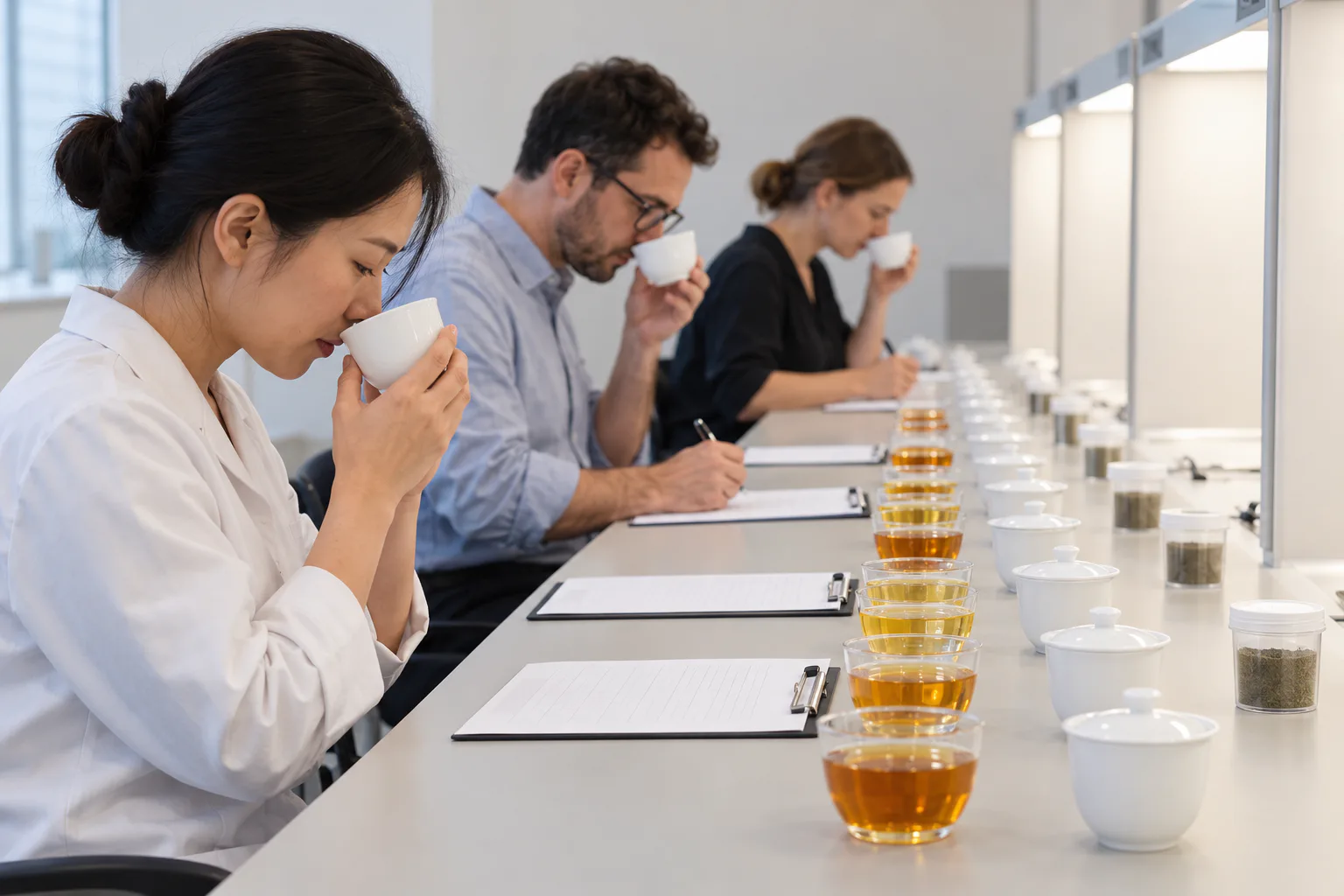
Step 7: evaluate mouthfeel with a controlled sensory method
Serve coded samples at the same temperature and dosage. Ask trained or aligned assessors to rate attributes such as:
- smoothness;
- fine grit;
- coarse particles;
- chalkiness;
- drying or astringent sensation;
- body and coating;
- aftertaste.
Grit and astringency can be confused. Tea polyphenols may create oral dryness even when the powder is physically fine. Use reference samples and a shared vocabulary to separate the sensations.
Move from the water screen to the complete beverage
The complete formula can reverse the ranking from a water test. Proteins, fat, sugar, acids, minerals and hydrocolloids change viscosity, wetting, aggregation and sensory perception.
Milk and plant-based beverages
Test tea addition before and after the milk or plant base where the process allows. Compare a direct-add method with a controlled pre-slurry only as separate documented trials. Observe clumping, color, foam and tea flavor after the full formula is mixed.
Protein-containing systems may respond to pH and heat. Do not attribute every particle or deposit to the tea powder without a formula control.
Acidified and fruit beverages
Add acids according to the intended sequence and measure the result after equilibrium. Watch for haze, flocculation, sediment and color change. If juice or flavor emulsions are present, include controls that separate their contribution.
Dry mixes
Evaluate blend uniformity, segregation, dust, reconstitution and package-to-package consistency. A powder that performs well when weighed individually may behave differently after storage in a multi-ingredient dry mix.
RTD products
Apply the intended homogenization, heat treatment and filling conditions at pilot scale. Observe immediate and time-dependent effects. Commercial shelf life must be established through a suitable stability and food-safety program; a short bench hold is not a shelf-life claim.
Diagnosing common dispersion problems
| Observation | Possible contributors | Questions to investigate |
|---|---|---|
| Powder floats | Trapped air, surface properties, low density, addition method | Was powder added slowly into a vortex? Would a validated pre-wet step fit production? |
| Dry-centered clumps | Rapid addition, insufficient wetting, agglomeration | Is mixing energy reaching the addition zone? Is the powder moisture-damaged? |
| Heavy sediment | Particle size, density, low viscosity, aggregation | Is the ingredient meant to suspend? What hold time is required? |
| Persistent foam | High shear, proteins, surface-active components | Can mixing energy or addition order change without harming dispersion? |
| Gritty mouthfeel | Coarse fraction, agglomerates, low hydration | Is grit physical or confused with astringency? What does microscopy or particle analysis show? |
| Ring on vessel | Surface film, foam collapse, particles at interface | Does it occur in the final pack and at the real dosage? |
| Haze after acid | Ingredient interaction, pH shift, precipitation | At what pH does it appear? Which component creates the interaction? |
The table is a troubleshooting map, not a diagnosis. Change one variable at a time and keep a control.
Should formulators use a stabilizer?
Stabilizers can reduce sedimentation in some beverage systems by changing viscosity, particle interactions or network structure. They can also change mouthfeel, flavor release, label declaration, processing and regulatory requirements.
Do not add a hydrocolloid simply because one published study reported improvement. Select it within the full formulation program. Screen type and concentration, check hydration order, confirm compatibility with pH and heat, and validate the sensory and regulatory result.
If the beverage can meet its target through ingredient selection and process control alone, that may simplify the formula. If a stabilizer is required, define its function explicitly and qualify the combined system.
Factory testing and installation preparation
Bench mixing cannot fully reproduce powder flow from a bag, dust extraction, tank geometry, recirculation or production hold times. A pilot or factory trial should document:
- receiving and conditioning of the powder;
- pack opening and resealing procedure;
- dosing accuracy and dust generation;
- powder addition point and rate;
- mixer and recirculation settings;
- time to reach uniform appearance;
- tank-wall and line deposits;
- filtration or pump response;
- yield, waste and cleaning observations;
- finished beverage at the start, middle and end of the run.
Installation preparation may include dry storage space, humidity control, safe powder handling, suitable scoops or transfer equipment, local dust controls and written addition instructions. These requirements should be discussed before the first full shipment, not discovered during production.
Connect the test to specifications and supplier control
The application test should lead to an approval record. Include:
- supplier and exact product code;
- approved sample and lot reference;
- test method and formula revision;
- sensory and physical acceptance criteria;
- particle-size information and test method where relevant;
- current product specification;
- required batch documents;
- commercial packaging and storage instruction;
- change-notification expectations;
- conditions that trigger re-evaluation.
Do not place a narrow application result directly into a universal raw-material specification without considering method variability and other uses. The specification should be measurable, relevant and agreed with quality and operations.
Common testing mistakes
Using different mixers for different samples
This prevents a fair comparison. Keep the screen controlled, then optimize separately.
Reporting only “passed” or “failed”
Record observable evidence, test conditions and the reason for the decision.
Assuming finer always means better
Finer powders can improve some attributes but may create handling or agglomeration challenges. Test the complete system.
Ignoring serving time
A beverage consumed immediately and an RTD held for months require different evaluation programs.
Confusing astringency with grit
Use aligned sensory vocabulary and reference samples to separate physical particles from oral drying.
Approving the sample without the commercial-lot plan
Define how future lots will be checked against the approved reference.
FAQ
What is the difference between dispersibility and solubility?
Dispersibility describes how particles distribute through a liquid; solubility describes material entering a molecular or ionic solution. Instant tea extract is generally selected for dissolution, while matcha and ultrafine leaf powders are evaluated as particle dispersions or suspensions.
Does smaller tea powder particle size prevent sediment?
Smaller particles can settle more slowly under some conditions, but size alone does not guarantee stability. Density, aggregation, viscosity, formula composition, mixing and storage also matter. Use particle data alongside a controlled finished-beverage test.
How long should a tea powder sedimentation test run?
Choose intervals that match the product’s use. A café drink may need minutes of observation, while an RTD requires a formal stability program. Short bench intervals are useful for screening but cannot establish commercial shelf life.
Why does tea powder clump when added to water?
Clumps can form when the outer surface wets rapidly and traps dry powder inside, or when powder is added faster than mixing can distribute it. Powder moisture, surface properties, temperature and addition method can all contribute.
Can high-shear mixing solve every dispersion problem?
No. Greater shear may break agglomerates but can also generate foam, change particle structure or exceed factory capability. Validate the lowest practical process that consistently meets the finished-product target.
Should a tea powder specification include particle size?
It may be useful for whole-leaf or ultrafine powders when the method and relevance are clear. State the test method and distribution metric, and connect the limit to application performance. A mesh claim or single micron number should not replace beverage testing.
Conclusion
Tea powder performance is a relationship among ingredient identity, particles, liquid, formula and process. A useful evaluation separates wetting, clumping, dispersion, sedimentation and mouthfeel; controls the test conditions; and then confirms the result in the actual beverage and factory process.
The strongest buyer decision is traceable. It links an identified sample to a repeatable method, a finished-product result, a current specification and a commercial-lot control plan. That record is more valuable than a claim that one powder is simply “finer” or “more soluble.”
Final CTA: discuss your tea powder application
Working on a latte, milk tea, powdered mix or RTD beverage? Send Your Requirements with the tea category, formula, mixing equipment, hold time and target sensory profile. Healsun can discuss relevant tea powder options and the product details to confirm before testing.
References
- Steam explosion enhances powder property, instant solubility and diffusivity of superfine ground tea powder
- Optimization of spray-drying process to manufacture green tea powder and its characteristics
- ISO/TC 34/SC 8 — Tea standardization scope
- FAO quality assurance guidance for dried herb and spice products