Introduction
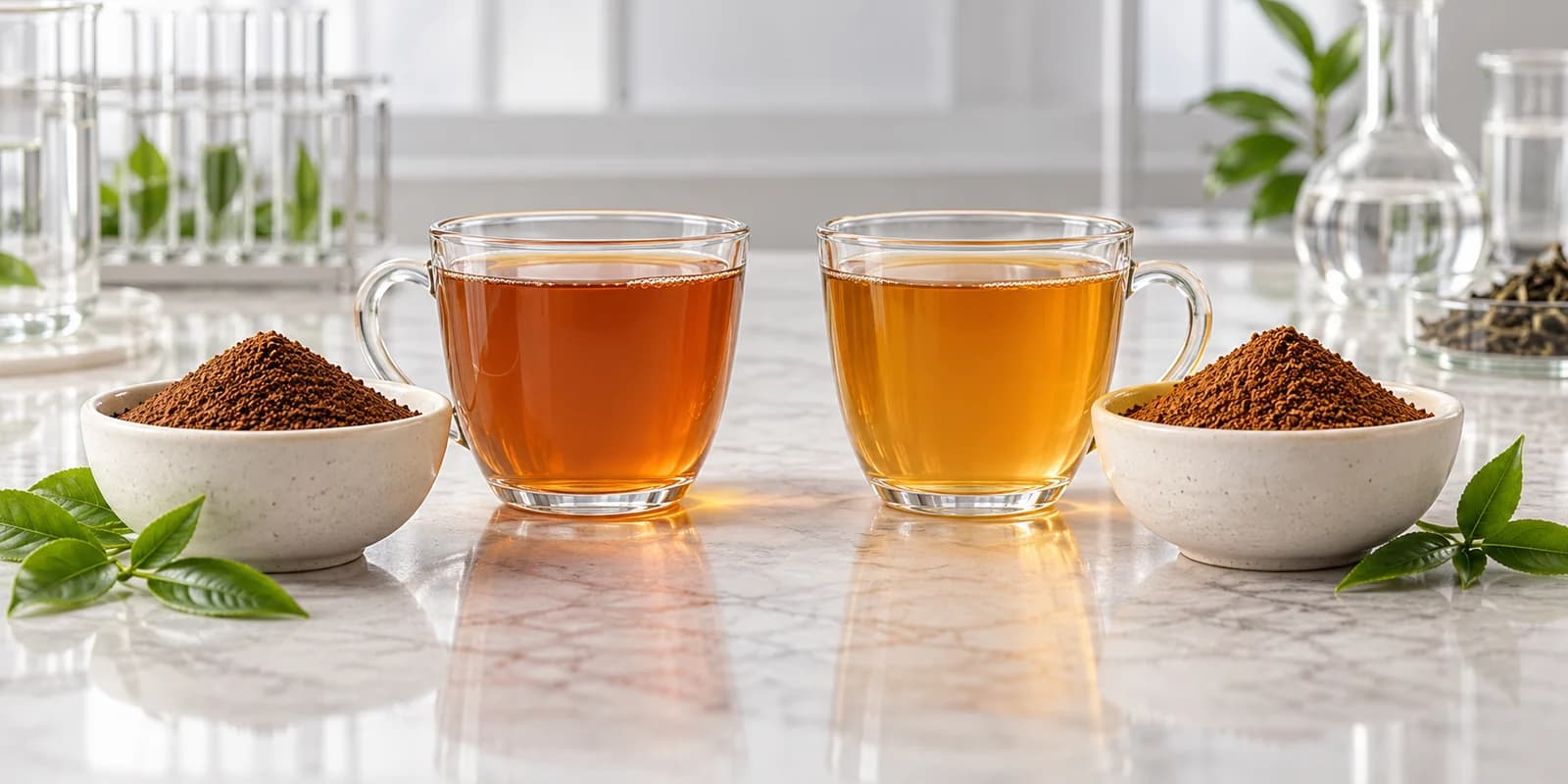
When the same tea powder produces different color, taste or haze in two locations, the ingredient may not be the only variable. Process water carries dissolved minerals, alkalinity and treatment residuals, and its composition can change by source, season or on-site treatment. Those differences can influence the beverage directly and can also change how tea components are perceived.
Short answer: Water quality can affect an instant tea beverage's pH, taste, color, aroma and visible stability. For meaningful supplier or formulation comparisons, use one documented water source, record pH, conductivity or total dissolved solids, hardness and alkalinity when relevant, and repeat promising samples in representative production water. Research on brewed tea demonstrates that mineral composition matters, but it should guide testing—not be converted into a universal instant-tea water specification.
This guide is educational. Potable-water compliance, treatment design and finished-beverage safety must be handled by qualified personnel under the rules that apply to the manufacturing site and market.
What buyers mean by water quality
Water quality is not a single number. For beverage trials, several properties may matter:
- pH: the measured acid–base condition at the time and temperature of testing;
- alkalinity: the water's capacity to neutralize acid, often important to finished pH response;
- hardness: primarily a measure related to dissolved calcium and magnesium, commonly expressed as calcium carbonate equivalent;
- conductivity or total dissolved solids: broad indicators of dissolved ionic material, not complete composition profiles;
- specific ions: calcium, magnesium, iron, sodium, bicarbonate, chloride and others may have different effects;
- disinfectant residuals and odor: chlorine-related notes or other treatment characteristics may influence sensory results; and
- microbiological suitability: a separate safety requirement that cannot be inferred from appearance, pH or mineral readings.
Two waters with similar total dissolved solids can have different ionic profiles. Two waters with the same pH can have different alkalinity and respond differently when acid is added. That is why “use purified water” is too vague for a transferable test method.
What research can—and cannot—tell us
Peer-reviewed studies of brewed tea have reported that water mineral content and pH can affect extraction, color, taste and volatile profiles. One study comparing several waters for green-tea brewing found differences associated with mineral composition and pH. Another controlled study found that increasing hardness changed catechin measurements and color in green-tea infusions. Research on tea-film formation also describes links among water hardness, tea components and surface film.
These findings establish a credible mechanism for treating water as an experimental variable. They do not establish one ideal water for all instant tea powders or finished beverages. Brewed leaves involve extraction; instant tea involves reconstitution of previously extracted solids. Finished formulas may contain acids, sugars, juice, protein, minerals and stabilizers that dominate the result. Use published research to design comparisons, not to skip application testing.
How individual water variables may appear in trials
pH and alkalinity
Initial water pH can influence the starting condition, but alkalinity often determines how strongly the water resists acidification. In an acidified RTD concept, the same acid addition may produce different finished pH values in waters with different alkalinity. Measure the completed formula rather than calculating finished pH from water pH alone.
Tea color and flavor can also be pH-sensitive. A difference is not automatically a defect or safety issue; it is a signal to compare water and process records.
Hardness and mineral ions
Calcium and magnesium define most conventional hardness, but specific ions matter. Minerals may interact with tea components or other formulation ingredients and influence color, turbidity, surface film or taste. Trace iron can be important even when total hardness appears ordinary. A single hardness number therefore provides a useful screening description but not a complete diagnosis.
Chlorine-related sensory effects
Municipal treatment can leave residual disinfectant. Its concentration and sensory impact vary. If a tea trial has an unexpected pool-like, medicinal or muted aroma, compare the water itself under the site's approved sensory and analytical procedures. Do not assume the powder caused the note.
Temperature and dissolved gases
Water temperature affects dissolution and sensory measurement. Heating can alter dissolved gases and some water characteristics. Record the temperature at preparation and measurement. If production uses heated, filtered or deaerated water, a cold tap-water bench test is not process-representative.
Create a water profile for reproducible testing
The purpose of a water profile is not to create an unnecessary certificate for every beaker. It is to preserve enough context to reproduce a decision.
Record:
- source and sampling point;
- date and time;
- relevant on-site treatment;
- temperature at use;
- pH measurement method and calibration status;
- conductivity or TDS, where useful;
- hardness and alkalinity, if relevant to the project;
- specific-ion or disinfectant data when a hypothesis requires it; and
- the exact tea sample, formula and preparation method.
Use approved laboratory methods and calibrated equipment. Consumer meters and test strips may be useful for rough screening, but their limitations should be stated.
A practical comparison protocol
Step 1: Define the decision
Examples include: selecting between two tea samples, explaining a site-to-site difference, checking whether treatment water changes the sensory result, or preparing for pilot production. One test should answer one defined question.
Step 2: Choose representative waters
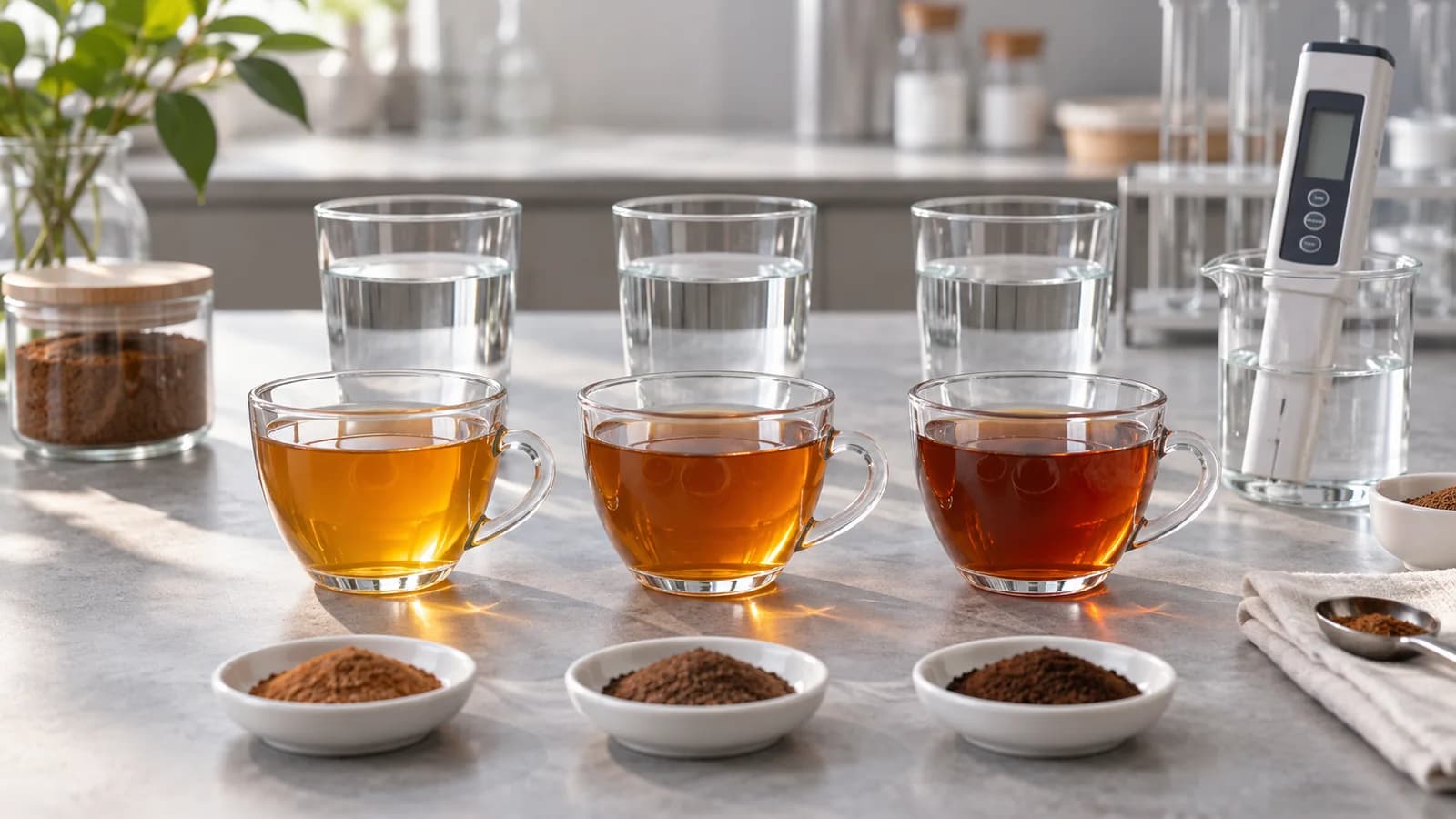
Use the current standard bench water as the control. Add the intended production water and, if technically justified, one contrasting water. Avoid comparing many poorly characterized sources at once. If treatment is proposed, compare the water before and after the named treatment under qualified control.
Step 3: Hold everything else constant
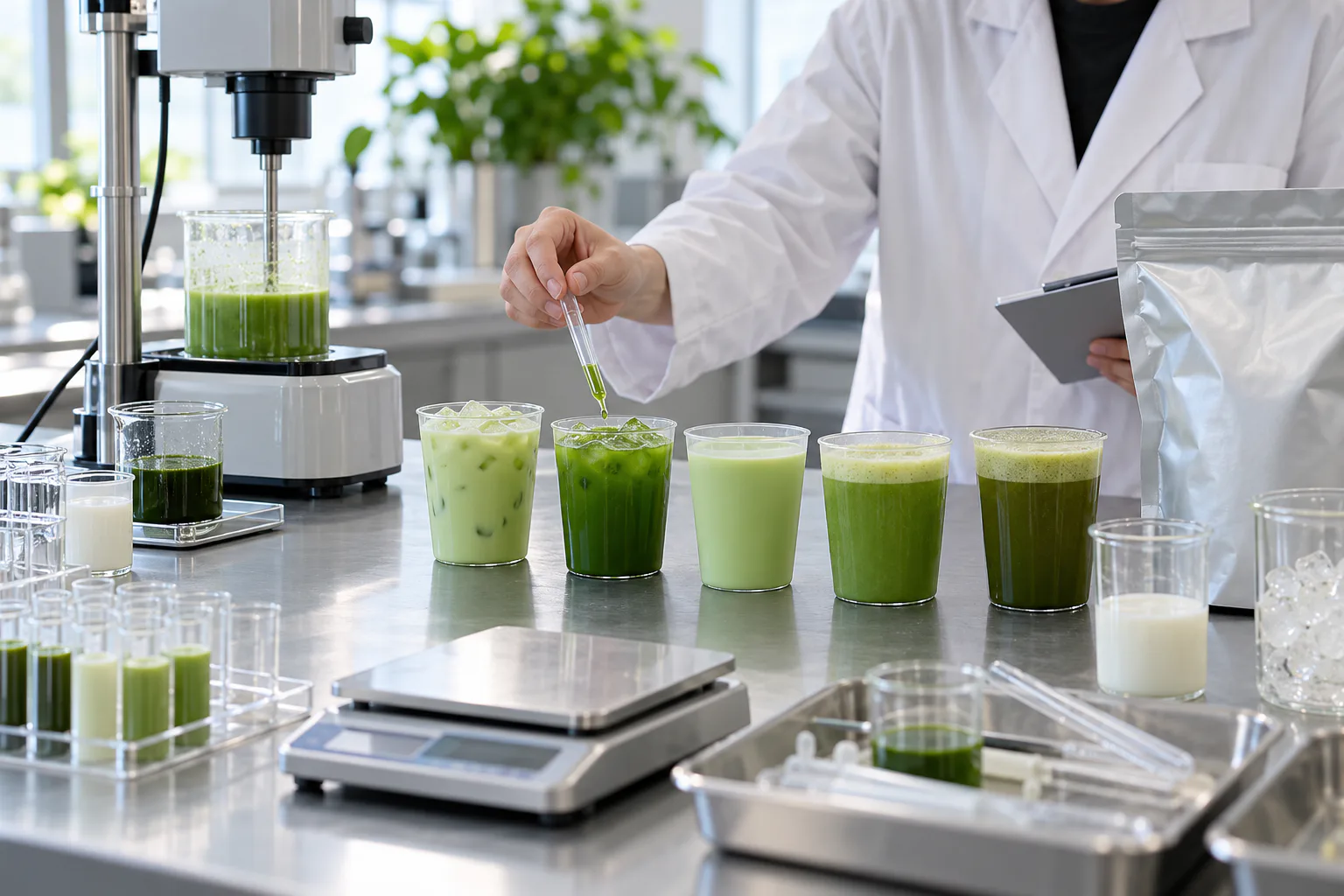
Use the same powder lot, dosage, formula, vessel, batch size, starting temperature, addition sequence, mixer, speed and time. Randomize or code samples for sensory work. Prepare replicates where the decision risk justifies them.
Step 4: Record the water before tea addition
Measure the selected variables using the same methods. Observe odor and appearance without treating sensory checks as a potability test. If the water is not approved for beverage work, do not use it in tasting.
Step 5: Prepare and inspect the tea system
At fixed times, record:
- dissolution or dispersion;
- color under controlled lighting;
- clarity, haze and surface film;
- aroma, bitterness, astringency and aftertaste;
- pH of the completed sample;
- visible sediment or wall deposition; and
- changes after the intended heat and cooling sequence.
Instrumental color, turbidity or particle measurements can strengthen comparison when available, but the method and units must be recorded.
Step 6: Test the complete formula
Plain-water reconstitution helps identify a water–tea difference. It does not predict a finished beverage containing acid, sweetener, juice, protein or stabilizer. Repeat the most relevant candidates in the complete formulation and intended process.
Step 7: Confirm in representative production conditions
A bench result can guide selection. Production approval should use representative water treatment, equipment, thermal process and package. If production water varies seasonally, the validation plan may need suitable challenge conditions selected by the technical team.
Troubleshooting common patterns
The tea is darker in one location
First compare sample identity, dosage, lighting, vessel, water pH, mineral profile, temperature and holding time. Published brewing research supports water-related color effects, but it does not prove causation in a particular instant beverage. Repeat the preparation using exchanged water: make both waters at the same site with the same operator and equipment if practical.
A surface film appears after standing
Tea-film research indicates that interactions involving tea components and water hardness can contribute to surface films in brewed tea. In a commercial formula, other ingredients and processing may also matter. Record the container, exposed surface, cooling and time. Do not describe a harmless-looking film as contamination without appropriate investigation.
Aroma seems muted with mineral water
Mineral composition can influence volatile profiles and sensory perception, but sweetness, serving temperature and glassware also affect aroma. Use coded comparison and the same time after preparation. Avoid compensating immediately with more tea, which may also change bitterness and cost.
Finished pH differs despite equal acid addition

Check alkalinity, measurement temperature, meter calibration, mixing and the complete formula. Water pH alone does not show buffering capacity. Treat the discrepancy as a formulation-control question and involve the responsible technical team.
The powder dissolves in laboratory water but not at the plant
Compare temperature, mixing energy, addition order and actual powder concentration before blaming water. Then conduct a water crossover test. A different result may arise from several variables acting together.
Water treatment: keep claims within evidence
Filtration, softening, reverse osmosis, deionization, activated carbon and blending serve different purposes. No treatment should be recommended solely from a tea-cup observation. Treatment can change mineral balance, alkalinity, disinfectant residuals, microbiological controls, corrosion behavior and operating requirements.
The beverage manufacturer should define objectives with qualified water and food-safety specialists, then validate the treated water and finished product. “More purified” is not automatically “better” for taste, process control or plant operation.
Questions for suppliers and internal teams
- What exact tea format and sample identifier are being tested?
- Which preparation conditions support the product's intended use?
- Is the observed residue expected for a soluble extract or a suspended leaf format?
- Which product-specific specification and lot documents are available?
- What water source and treatment were used during the buyer's evaluation?
- Are bench and production water profiles materially different?
- Which acceptance criteria belong to ingredient approval, and which belong to the finished beverage?
- Who owns potable-water, process and destination-market validation?
This separation prevents a water-system variable from being incorrectly recorded as an ingredient failure—or an ingredient identity question from being hidden inside water treatment.
Frequently asked questions
What water is best for instant tea powder?
There is no universal best water. Use potable, approved water that fits the manufacturing process, then compare controlled profiles against the product's sensory and physical targets. Lower mineral water may suit some concepts, while another formula may require a different balance.
Does hard water stop instant tea from dissolving?
Hardness may influence appearance and tea-component interactions, but poor dissolution can also result from temperature, addition order, concentration or mixing. A controlled crossover test is more reliable than a general assumption.
What is the difference between hardness and alkalinity?
Hardness mainly describes calcium and magnesium content, usually as calcium carbonate equivalent. Alkalinity describes acid-neutralizing capacity. They can be related in some waters but are not interchangeable measurements.
Can pH alone predict tea color?
No. pH is relevant, but tea type, concentration, minerals, oxygen, heat, other ingredients and time also affect color. Evaluate the finished system.
Should distilled water be used for supplier comparisons?
It can provide a controlled reference in some laboratory studies, but it may not represent production. Use it only when it answers a defined question, and always confirm in representative approved water.
How often should process water be checked?
The monitoring frequency should follow the site's approved water-safety, quality and process-control program and applicable requirements. This article does not prescribe a compliance schedule.
Conclusion
Water is an ingredient and a process variable. A useful instant-tea trial records where the water came from, how it was treated, its relevant measurements and how the beverage was prepared. Controlled water crossover testing can prevent false conclusions about tea samples and improve transfer from bench to plant. Published tea research helps identify plausible variables, but every commercial formula still needs its own validation.